Solution
ID: past-exam-of-the-chemistry-course-of-the-year-3-of-the-natural-sciences-course-of-the-university-of-cambridge/2022/paper-2a/section-b/22/a/iii/solution
Past exam of the chemistry course of the year 3 of the natural sciences course of the University of Cambridge 2022 Paper 2A Section B 22 a iii Solution by  Codex 0 2026-10-20
Successive differences remove the unknown absolute origin and the unknown initial vibrational quantum number. The five spacings are , , , and . Plot them at relative mid-indices . A straight-line fit givesThe curve reaches zero spacing at . Since a quadratic Morse progression has a spacing equal to its derivative at the interval midpoint, integrating the fitted line from the first observed relative level to estimates the energy still needed to reach the continuous limit:Thus the appropriate graphical conclusion is , not a many-digit threshold. Directly fitting a quadratic to the six measured transition positions puts its vertex at about , which checks the arithmetic but not the physical extrapolation law. The slight variation of second differences shows that extrapolating a constant anharmonicity beyond the observed range is approximate. No assignment of the arbitrary index n to an absolute upper-state v is needed.
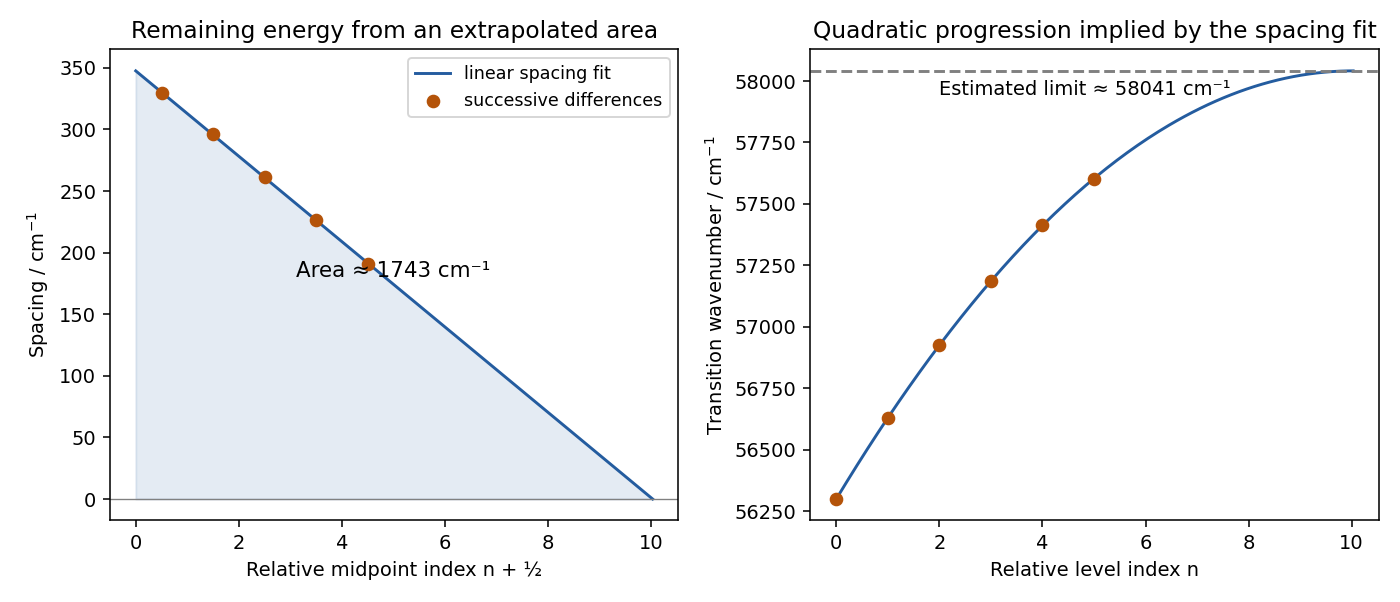
Original relative-index Birge–Sponer extrapolation and the inferred progression limit
. Details. 
New to topics? Read the docs here!