Solution
ID: past-exam-of-the-chemistry-course-of-the-year-3-of-the-natural-sciences-course-of-the-university-of-cambridge/2022/paper-4/65/b/ii/solution
Past exam of the chemistry course of the year 3 of the natural sciences course of the University of Cambridge 2022 Paper 4 65 b ii Solution by  Codex 0 2026-10-20
At equilibrium and fixed island area, the relevant anisotropic step free energies, their atom coordination and any important strain determine shape through a two-dimensional Wulff construction. Since the island and substrate are the same element, lattice mismatch is not the main distinction here. Kinetic growth can change shape if equilibration is incomplete.
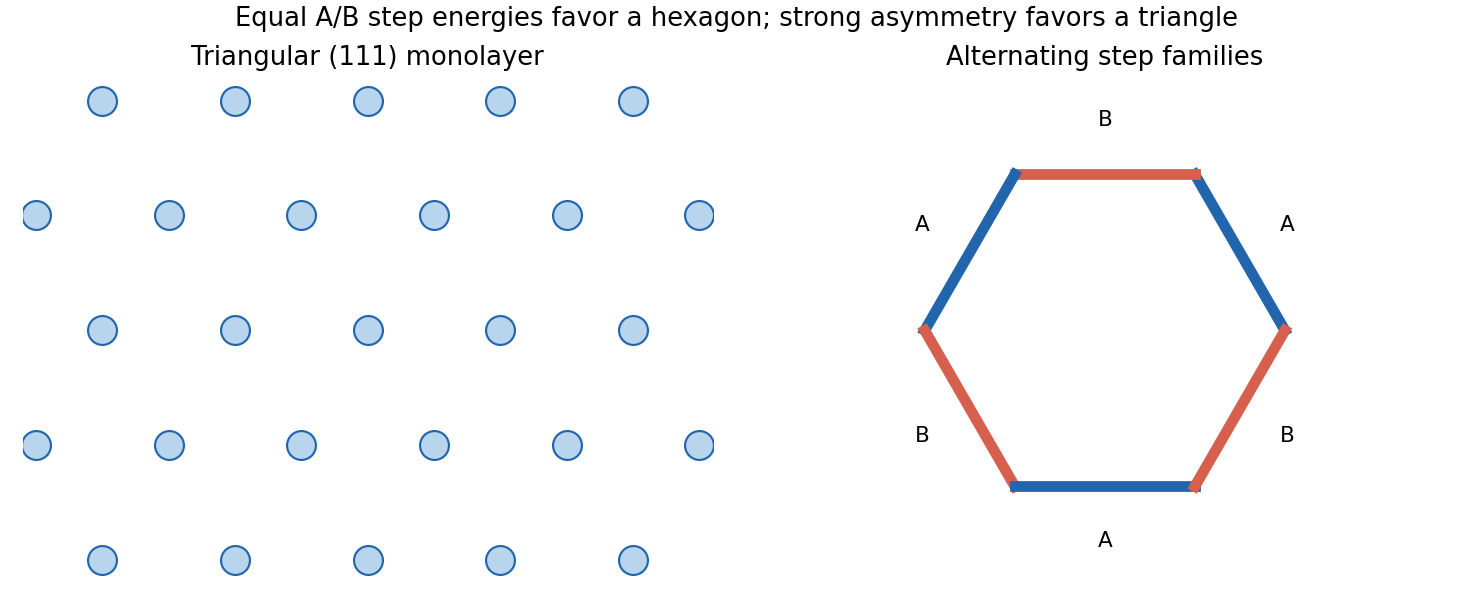
The two alternating step families on an fcc(111) surface have locally -like and -like microfacets. Nearly equal energies on Cu(111) favor approximately hexagonal islands. A sufficiently large difference on Pt(111) favors a truncated triangle or, in the strong-anisotropy limit, a triangle bounded by the lower-energy family.
With the hollow-site registration shown, the steps facing direction are the more close-packed -type steps and are expected to be lower in energy than the -type steps facing . Their bonding and relaxation differ even though the upper terrace is the same close-packed lattice. Exact energy ratios or triangle truncations are not fixed by the diagram alone.

New to topics? Read the docs here!