Solution
ID: past-exam-of-the-chemistry-course-of-the-year-4-of-the-natural-sciences-course-of-the-university-of-cambridge/2022/paper-2/section-a/18/e/solution
Past exam of the chemistry course of the year 4 of the natural sciences course of the University of Cambridge 2022 Paper 2 Section A 18 e Solution by  Codex 0 2026-10-20
Pendant alcohols can form reversible borate bridges, schematically and , where P and P′ belong to different chains. Tetrahedral borate species are also possible depending on pH and water content. A bridge must connect different network strands to act as a cross-link; an intrachain loop does not contribute equivalently to elasticity.
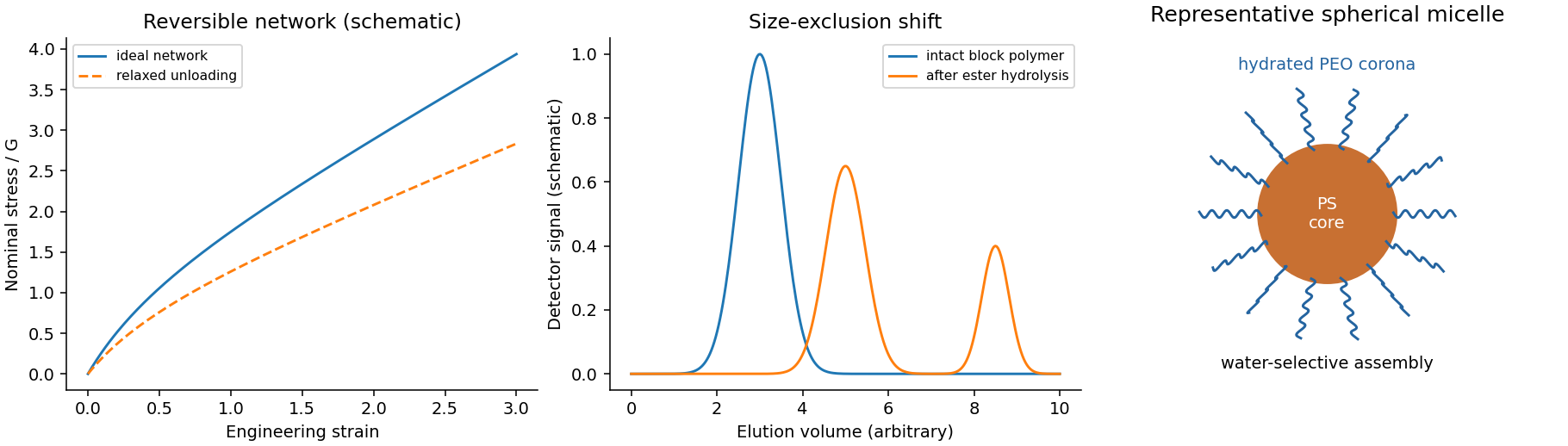
Between cross-links, stretching reduces the number of accessible chain conformations. A simple incompressible rubber elasticity model gives the nominal tensile stresswhere is the extension ratio and the density of elastically active strands. The initial response is soft; stronger extension gives increasing stress and ultimately finite-chain extensibility. Reversible borate exchange permits stress relaxation, rate dependence and a loading–unloading hysteresis loop, rather than permanent ideal elasticity at arbitrarily long times.

New to topics? Read the docs here!