Solution
ID: past-exam-of-the-chemistry-course-of-the-year-4-of-the-natural-sciences-course-of-the-university-of-cambridge/2022/paper-3/section-e/45/b/solution
Past exam of the chemistry course of the year 4 of the natural sciences course of the University of Cambridge 2022 Paper 3 Section E 45 b Solution by  Codex 0 2026-10-20
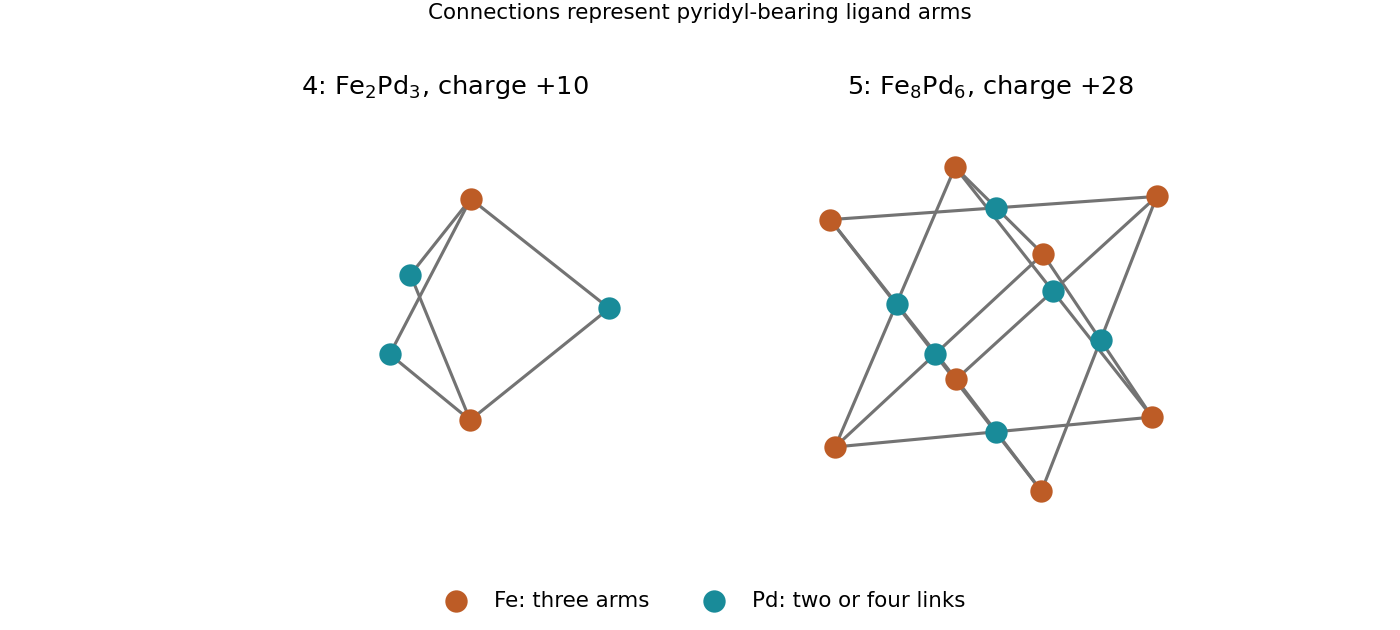
Each Pd(dppp) unit retains its chelating phosphine and offers two adjacent pyridyl binding sites at an approximately right angle. Three such units bridge pairs of metalloligands, giving , a trigonal bipyramid with two Fe vertices and three equatorial Pd vertices. All six outward pyridines are used: . The Pd/Fe ratio is , matching the reagent dose, and the cation charge is because the organic ligands are neutral.
The two donor sites left by dppp are cis, so each equatorial Pd joins one arm from each Fe cap. A mere mass-spectral maximum charge is not an independent structure determination, but its consistency with donor counting and binding geometry strongly selects this model.

New to topics? Read the docs here!