Solution
ID: past-exam-of-the-chemistry-course-of-the-year-4-of-the-natural-sciences-course-of-the-university-of-cambridge/2022/paper-id/3/a/solution
Past exam of the chemistry course of the year 4 of the natural sciences course of the University of Cambridge 2022 Interdisciplinary paper IDP1 3 a Solution by  Codex 0 2026-10-20
Photodissociation of nitrogen dioxide forms an oxygen atom, followed by third-body recombination:If NO is converted back to nitrogen dioxide only by , this is a null cycle with no net ozone production. Oxidation of a volatile organic compound by OH generates organic peroxy radicals, and often hydroperoxyl radicals, which instead oxidize NO without consuming ozone:The newly formed nitrogen dioxide can then photolyse, giving net ozone production. These chain reactions require sunlight, radical production and both precursor families.
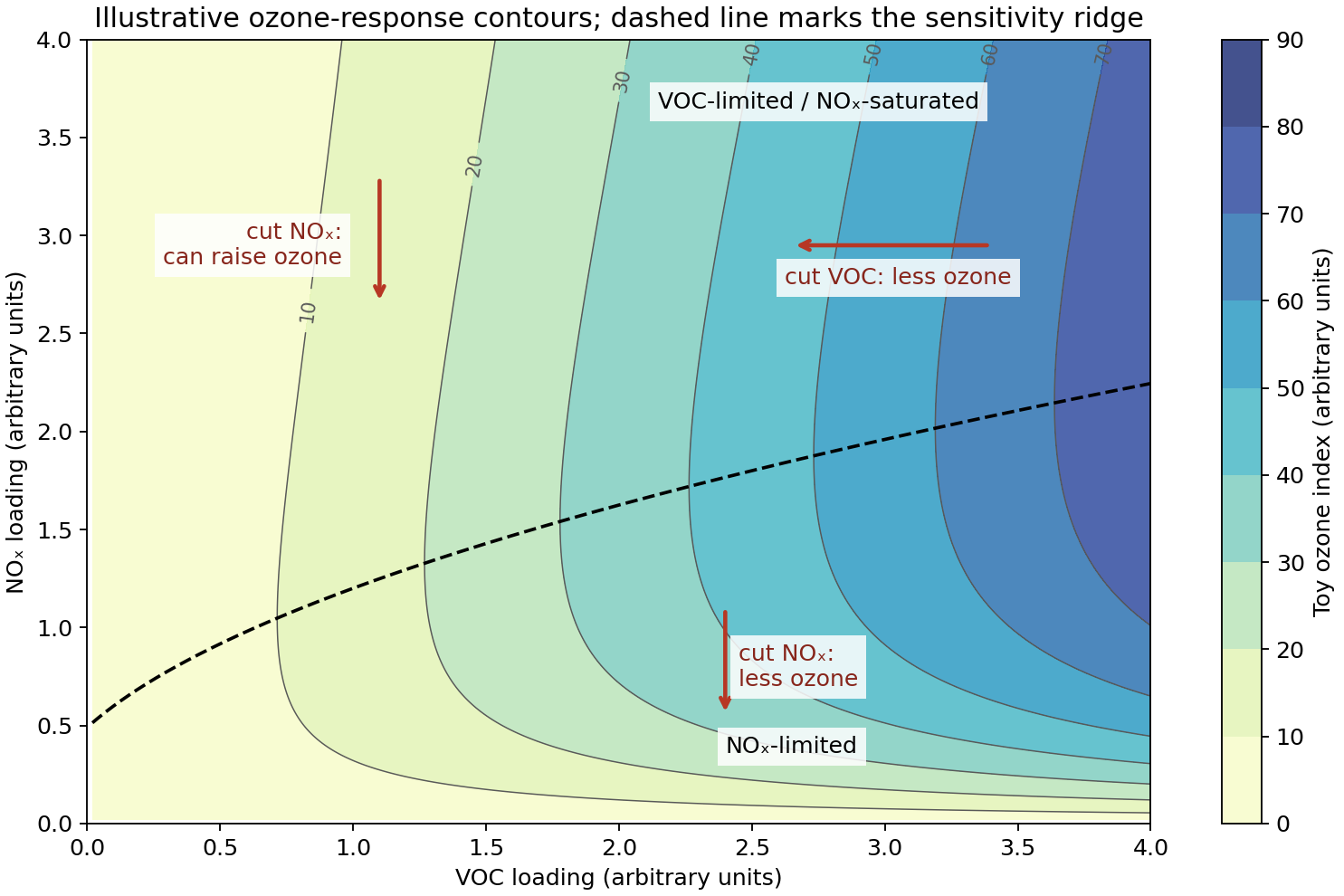
In an NOx-limited ozone-production regime, NO is too scarce for efficient peroxy-radical conversion; competing peroxide-forming radical termination becomes important. Reducing nitrogen-oxide emissions then reduces ozone production. In a VOC-limited ozone-production regime, plentiful nitrogen oxides remove OH through , so organic oxidation and radical supply are limiting. Reducing volatile-organic emissions is effective there, while a modest nitrogen-oxide reduction can initially increase ozone by reducing radical termination and NO titration. Sufficiently large nitrogen-oxide reductions can move the system into the limited regime and eventually lower ozone. The appropriate control therefore depends on the chemical regime and the regional transport history, not merely the largest local emission. The ozone isopleth diagram below uses an explicitly schematic response function to show derivative signs, not a fitted concentration or emissions-control prediction.[ref]
The sensitivity of ozone to nitrogen oxides and hydrocarbons in regional ozone episodes by Sanford Sillman and others. Journal of Geophysical Research 95 (1990), pp. 1837–1851, model comparison of rural and urban precursor sensitivity

New to topics? Read the docs here!