Solution
ID: past-exam-of-the-chemistry-course-of-the-year-4-of-the-natural-sciences-course-of-the-university-of-cambridge/2022/paper-id/3/d/ii/solution
Past exam of the chemistry course of the year 4 of the natural sciences course of the University of Cambridge 2022 Interdisciplinary paper IDP1 3 d ii Solution by  Codex 0 2026-10-20
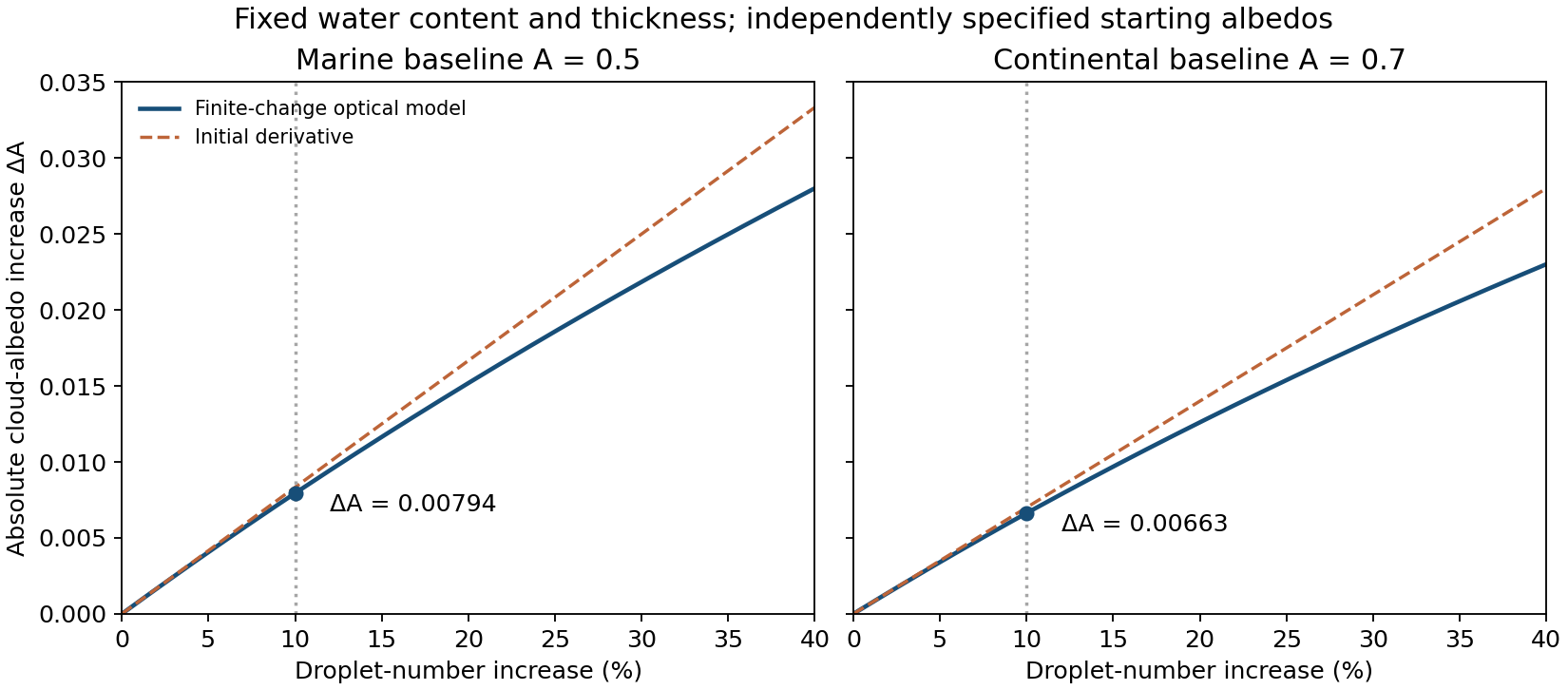
For a small fractional change , use . With the changes areThus the respective albedos become approximately 0.5083 and 0.7070 in the first-order calculation. These are increases of 0.83 and 0.70 percentage points, not 0.83% and 0.70% relative changes. Relative to the initial albedos, the increases are about 1.67% and 1.00%.
The exact finite-change version of the stipulated optical model is with , giving and . Its slightly smaller changes are consistent with curvature neglected in the differential approximation. For equal fractional number increases, the cleaner, intermediate-albedo marine cloud is somewhat more susceptible; for equal absolute number increases its susceptibility would be much greater because of the extra factor. The two starting albedos are treated as the supplied separate baselines, not as an exact common-proportionality calibration of the approximate optical-depth law.

New to topics? Read the docs here!