Solution
ID: past-exam-of-the-computer-science-course-of-the-university-of-oxford/2015/intelligent-systems/3/b/iii/solution
Past exam of the computer science course of the University of Oxford 2015 Intelligent systems 3 b iii Solution by  Codex 0 2026-10-31
Use the ordinary treewidth of the primal graph of the constraint hypergraph: two variables are adjacent whenever they occur together in an all-different constraint. Equivalently, a tree decomposition of this constraint hypergraph has a bag containing every constraint scope, together with the running-intersection requirement for each variable. This is distinct from taking the treewidth of its incidence drawing.
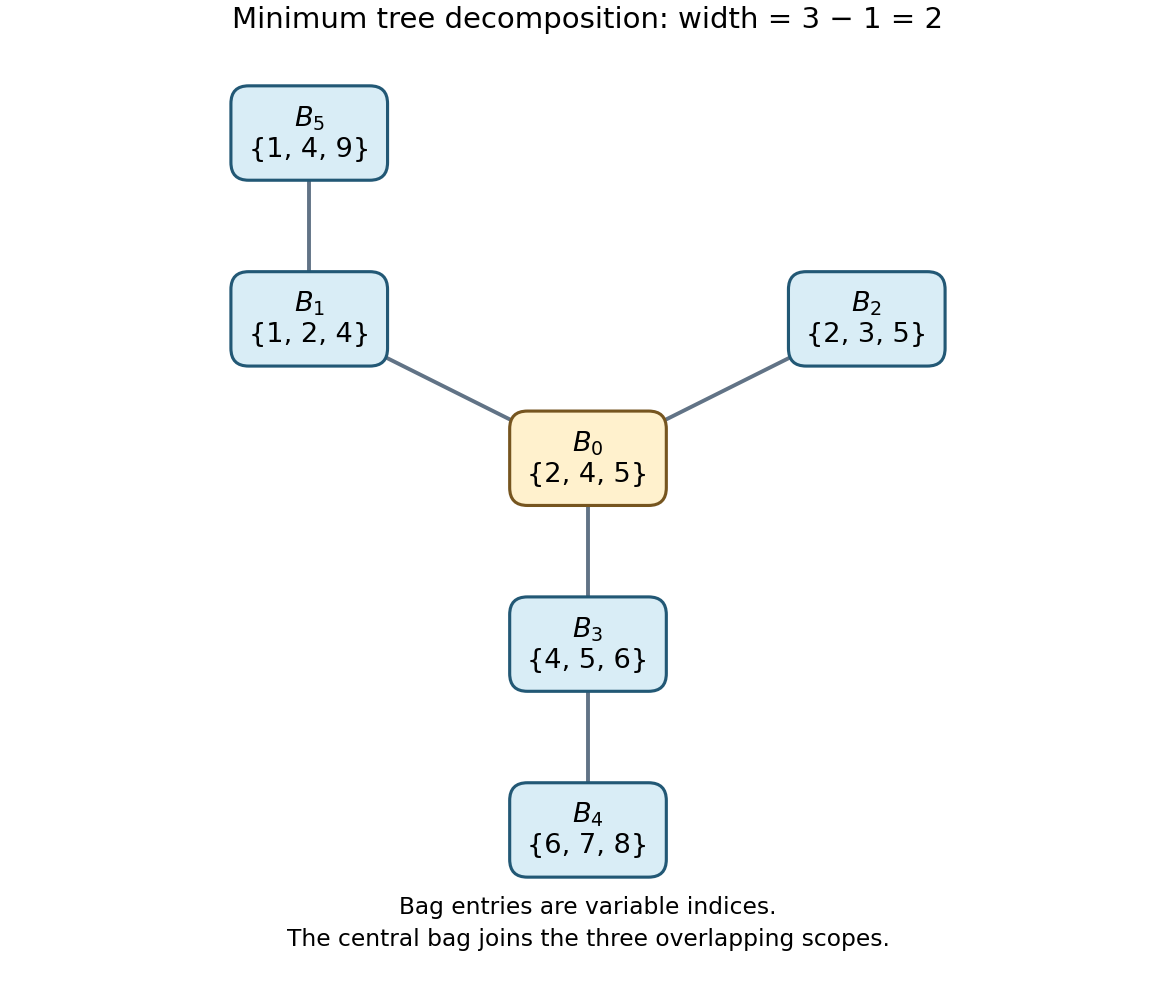

Every constraint scope is contained in its own bag, and every variable occurs. The nontrivial running-intersection checks are: occurs along ; along the connected branches ; along ; along ; and along . Each of the other variables occurs in just one bag. This is therefore a valid tree decomposition of width .
Conversely, any of the original three-variable constraint scopes forms a clique of size three in the primal graph. Such a clique must be contained in one bag of every tree decomposition, forcing width at least two. The upper and lower bounds agree:
New to topics? Read the docs here!