Solution
ID: past-exam-of-the-condensed-matter-physics-course-of-the-university-of-oxford/2016/4/c/i/solution
Past exam of the condensed matter physics course of the University of Oxford 2016 4 c i Solution by  Codex 0 2026-10-25
The supplied sound speed determines the spring-to-mass ratio without needing either parameter separately:ConsequentlyThe curve is even in , rises linearly from the origin with one-sided slopes km/s, and flattens at both zone edges. Its maximum is rad/s, or ordinary frequency THz. Keeping angular frequency distinct from cycles per second avoids a factor-of- error. Repeating the curve outside the first zone is a representation of equivalent crystal momenta, not the discovery of additional modes.
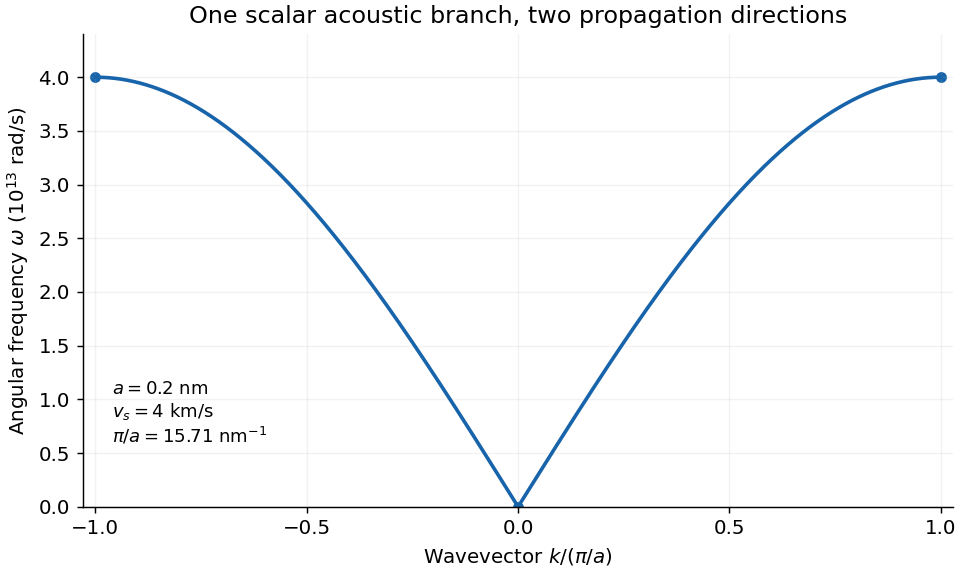
Positive-frequency acoustic dispersion of the specified monatomic chain
. Original nearest-neighbor harmonic-chain calculation, with both propagation directions in one first Brillouin zone. The plotted vertical frequency is angular frequency. Details.
New to topics? Read the docs here!