Solution
ID: past-exam-of-the-frontiers-of-observational-astrophysics-course-of-the-university-of-cambridge/2012/paper-1/1/b/solution
Past exam of the frontiers of Observational Astrophysics course of the University of Cambridge 2012 Paper 1 1 b Solution by  Codex 0 2026-10-20
Use the projected baseline along the source offset, , and . The first bandwidth null occurs at . A worst-case gives . That is a zero of the response, not a good usable bandwidth. A quantitative maximum needs an allowed attenuation.
For example, requiring a response of at least gives at . Hencefor that worst projection. A strictly east-west offset in a sides-aligned square instead samples at most , giving a first null and a ten-percent-loss bandwidth. The original two-antenna geometry supplies an additional projection; these examples use its maximum magnitude. Thus a bandwidth of order is a reasonable conservative estimate with a stated small-loss criterion, rather than a unique geometry-free limit.
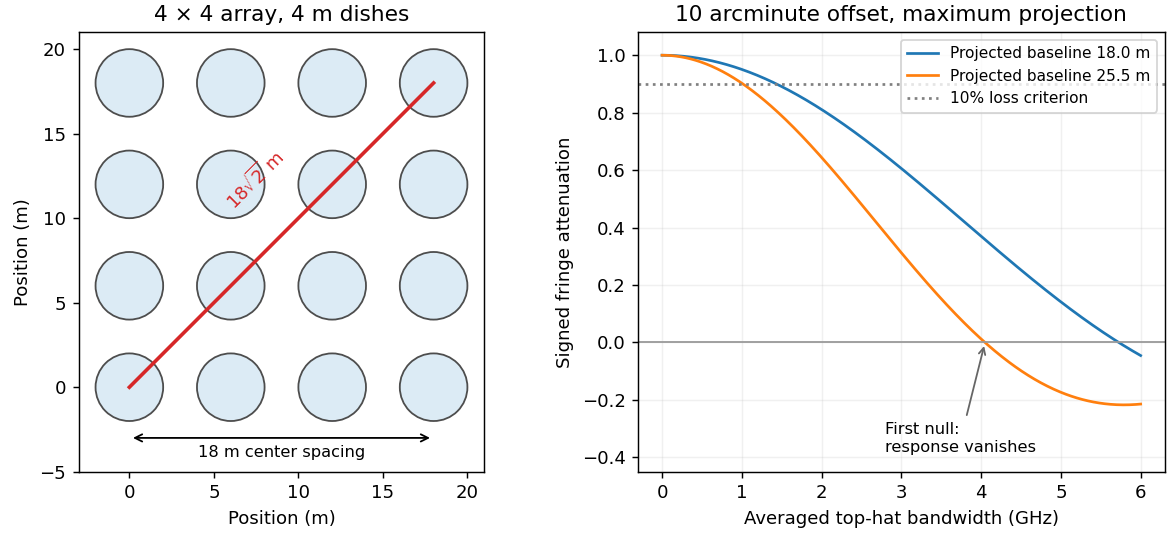
Array baselines and bandwidth decorrelation away from the tracking center
. Original array geometry and rectangular-band sinc calculations for a ten-arcminute offset. The marked ten-percent-loss bandwidth is an illustrative response criterion; the first null is not a usable-bandwidth recommendation. Details.
To use a much wider total band, channelize the signals before correlation or before irreversible frequency averaging. Correlate sufficiently narrow channels, track the reference delay and phase at each frequency, and combine frequency-aware visibilities or images. This preserves sensitivity while avoiding field-dependent averaging losses in radio interferometry. Merely adding a phase correction after a broad channel has decorrelated cannot recover the lost signal; nor can one tracking delay cancel every sky direction simultaneously.[ref]
Field of View by National Radio Astronomy Observatory. VLA Observational Status Summary 2018A, bandwidth and time-averaging limitations
New to topics? Read the docs here!