Solution
ID: past-exam-of-the-graph-theory-course-of-the-university-of-oxford/2011/1/a/solution
Past exam of the graph theory course of the University of Oxford 2011 1 a Solution by  Codex 0 2026-10-31
The Ramsey number is the least integer such that every graph on vertices contains either a clique of size or an independent set of size . Equivalently, every red-blue colouring of the edges of contains a red or a blue .
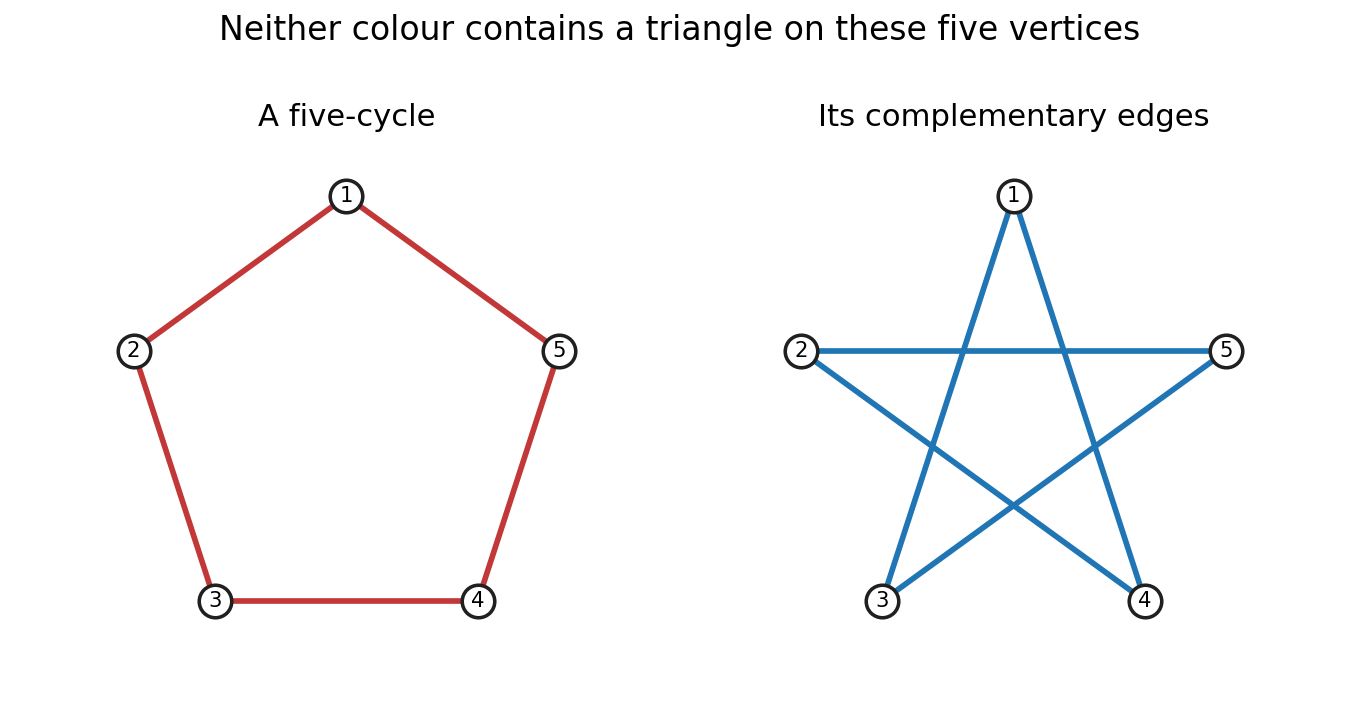
Put , and consider a graph on vertices. Fix a vertex . If it has at least neighbours, their induced graph contains either a clique of size , which together with gives a clique of size , or an independent set of size . Otherwise has at least nonneighbours. Their induced graph contains either a clique of size , or an independent set of size , which can be enlarged by . ThusSince , this gives . For the reverse bound, the five-cycle has no triangle and no independent set of size three: its complement is again a five-cycle, so it too is triangle-free. Hence the property fails on five vertices and

New to topics? Read the docs here!