Solution
ID: past-exam-of-the-integer-programming-course-of-the-university-of-oxford/2011/3/d/solution
Past exam of the integer programming course of the University of Oxford 2011 3 d Solution by  Codex 0 2026-10-31
Use the minimization form in this part. Treat every diagonal arc as forbidden, not as a zero-cost loop. The assignment relaxation of the travelling salesman problem requires one incoming and one outgoing arc at each city but permits several disjoint directed cycles. Its optimum is a lower bound on the tour optimum.
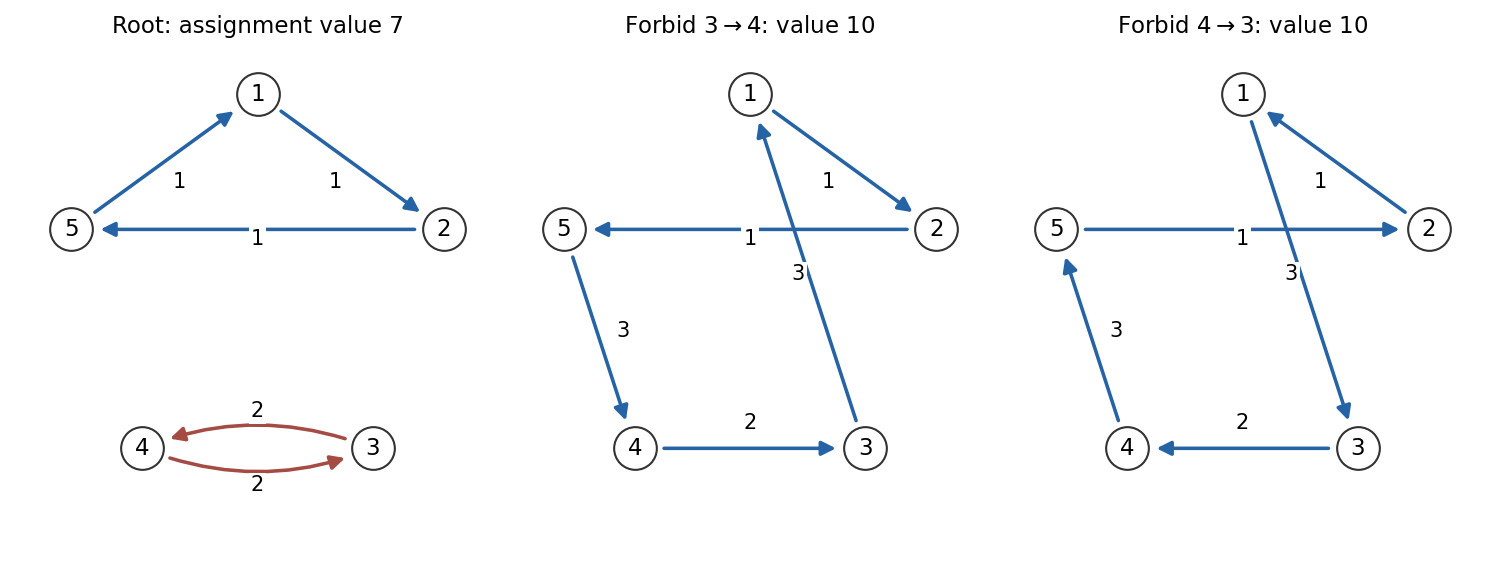
At the root chooseFor every allowed arc, . Their total is seven. The assignmentuses only tight arcs and has cost . The minimization certificate from part (c) therefore provesIt is not a tour, because it has a three-cycle and a two-cycle.
Branch on the two-cycle. Every five-city tour omits at least one of and , so the children and cover every possible tour. They may overlap, which does not invalidate the bounds.
For the child , useThese satisfy on every allowed arc of that child and sum to ten. The tourhas cost and uses tight arcs, certifying that the child assignment bound is exactly ten.
For the child , interchange the roles of cities three and four in those potentials. Its lower bound is again ten, attained bywith cost . Thus both first-level assignment optima are already tours.
There is a useful direct interpretation of the improved bound. Split the cities into and . A forbidden arc of the two-cycle forces an assignment arc from to , and balance forces at least one from to . Relative to the root potentials, each crossing arc has reduced cost , so any child assignment costs at least .
The first branching therefore completes the search: each child's lower bound equals a feasible tour value. Hence

New to topics? Read the docs here!