Solution
ID: past-exam-of-the-materials-science-course-of-the-university-of-cambridge/2015/paper-1/2/a/solution
Past exam of the materials science course of the University of Cambridge 2015 Paper 1 2 a Solution by  Codex 0 2026-10-20
The normal to the section is , so its in-plane principal vibration directions are and . Their refractive-index difference isThe slow direction is . The optical path retardation isAt an angle between a principal direction and the polarizer, ideal crossed-polar transmission has the formwhere is the intensity after the first polarizer. The two components recombine parallel to the incident polarization when , and the crossed analyser removes them. ConsequentlyThe next order is260nm, outside ordinary visible illumination. At exact principal-axis alignment, and every wavelength is extinguished, explaining the black appearance rather than a special single-wavelength cancellation.
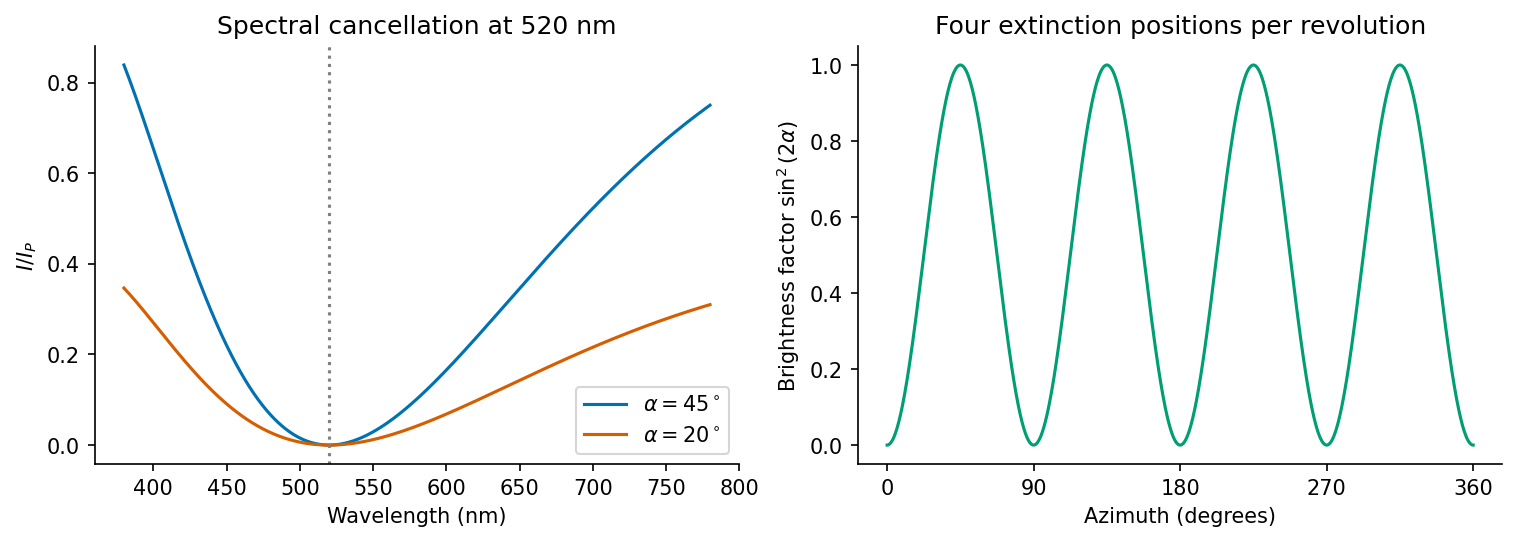
Original crossed-polar transmission calculation for the given retardation, including the visible extinction wavelength and azimuthal brightness factor
. Details. 
New to topics? Read the docs here!