Solution
ID: past-exam-of-the-materials-science-course-of-the-university-of-cambridge/2015/paper-1/3/a/solution
Past exam of the materials science course of the University of Cambridge 2015 Paper 1 3 a Solution by  Codex 0 2026-10-20
The materials interpretation is a cooling-rate gradient in a near-eutectoid steel. Before transformation, the parent thermodynamic phase is austenite. A small section can cool rapidly enough to suppress diffusional decomposition and form martensite, a supersaturated, highly strained transformation product. A much thicker interior cools more slowly and can transform diffusively to pearlite: alternating ferrite and cementite lamellae grouped into colonies. Bainite or mixed products are also possible for intermediate histories.
The likely contrast is therefore a martensite-rich rapidly cooled region and a more pearlitic slowly cooled interior. Brittle fracture is promoted by the highly strained martensitic state, residual stresses and local stress concentration. A larger intact interior need not share the same microstructure or local loading. The observations are consistent with this contrast, not a measurement proving pure thermodynamic phases everywhere.
The sketches below are generic steel microstructures, rather than a component design or fabrication prescription. No cooling curve, dimensions or transformation diagram is provided, so exact thermodynamic phase fractions, plate sizes and a universally pearlitic centre cannot be inferred.
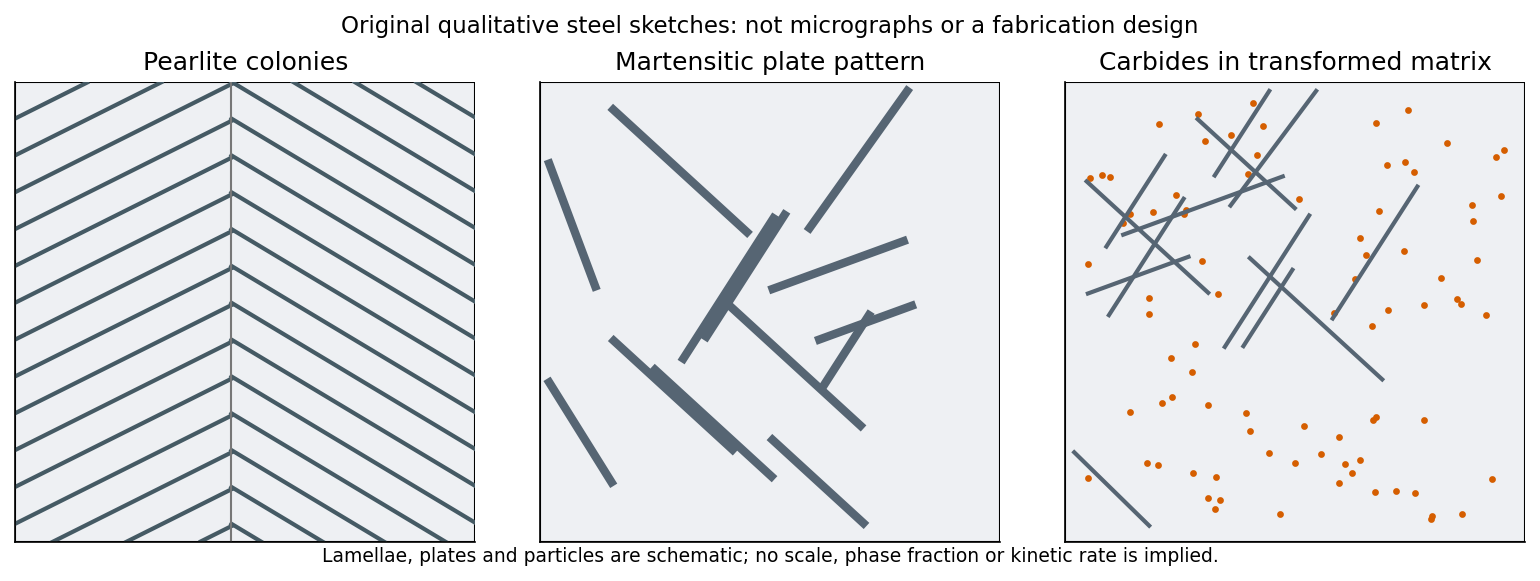
Original qualitative steel microstructure sketches: lamellar pearlite, a strained martensitic plate structure and carbide precipitation within a transformed matrix
. Details. 
New to topics? Read the docs here!