Solution
ID: past-exam-of-the-materials-science-course-of-the-university-of-cambridge/2019/paper-1/5/c/solution
Past exam of the materials science course of the University of Cambridge 2019 Paper 1 5 c Solution by  Codex 0 2026-10-20
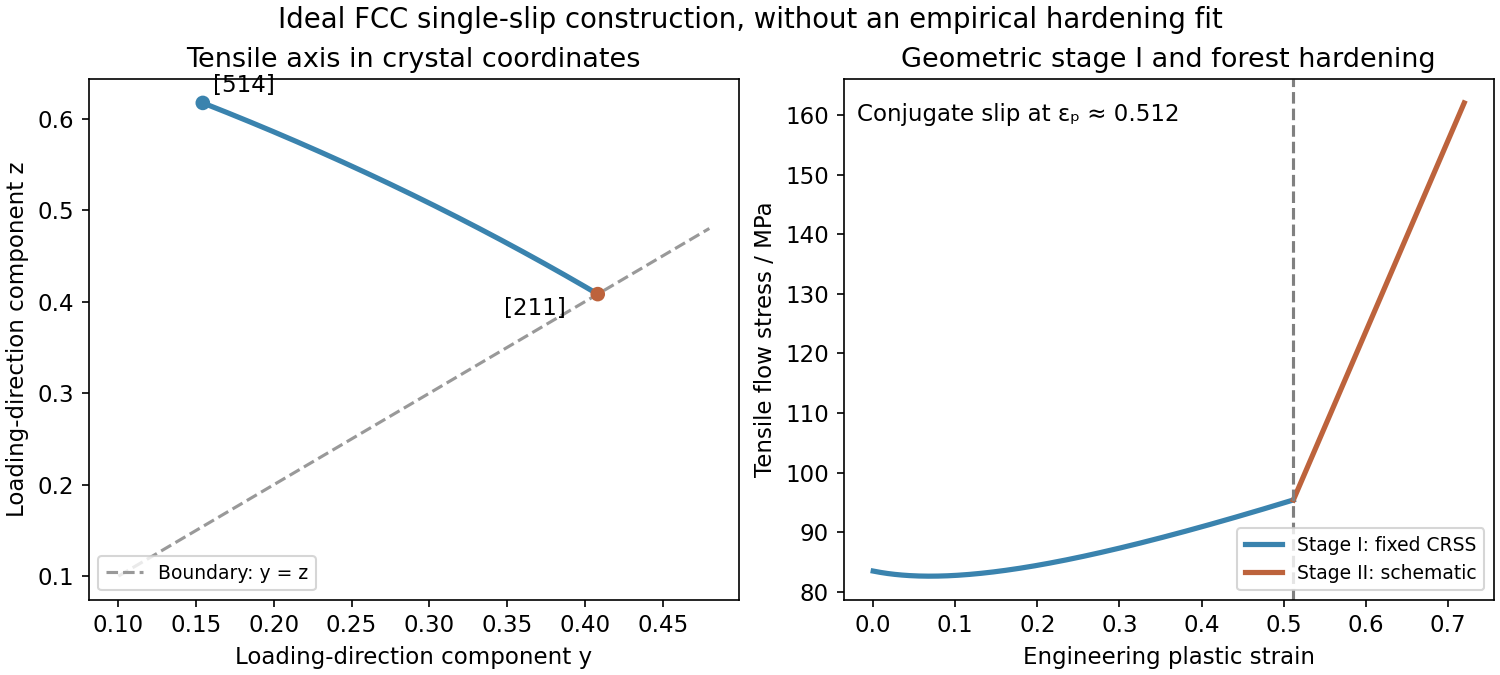
Initially, one slip system carries most of the deformation. Easy dislocation glide gives the nearly flat stage-I response, although lattice rotation and gradual dislocation interactions can already change the required tensile stress. In tension the loading direction expressed in the rotating crystal approaches the primary slip direction. Its path has the form until it reaches the symmetry boundary , at .
At that orientation, and have equal Schmid factors, . Conjugate slip therefore becomes competitive. Intersections between the two dislocation families generate obstacles, junctions and forest hardening, giving the sharp stage-II rise in flow stress. This is the ideal single-slip-to-conjugate-slip construction; real activation stresses can be shifted by latent hardening and imperfections.

New to topics? Read the docs here!