Solution
ID: past-exam-of-the-mathematical-methods-ii-course-of-the-university-of-oxford/2014/10/b/solution
Past exam of the mathematical methods II course of the University of Oxford 2014 10 b Solution by  Codex 0 2026-10-25
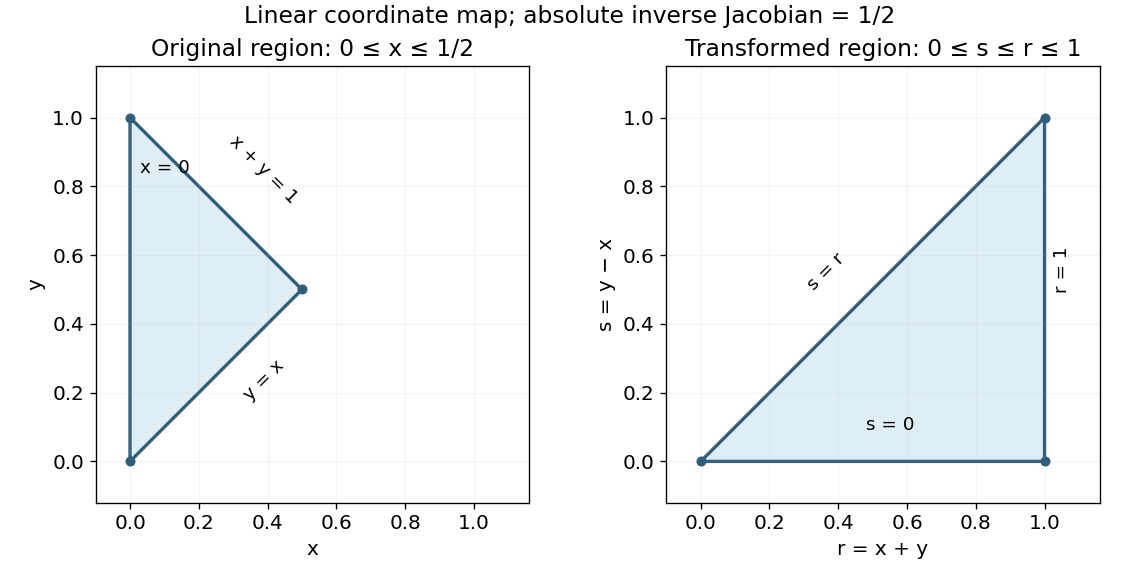
The original integration region is the triangle with vertices , and . Under , , its inverse map is , , with absolute inverse Jacobian determinant . The boundaries , , become , , . Thus the transformed triangle is , andThe endpoint singularities are integrable after the inner integral: is only a collapsed vertex, while has the usual inverse-square-root behavior. The diagrams indicate the complete triangles, rather than rectangular bounds that would include points absent from the original region.

New to topics? Read the docs here!