Solution
ID: past-exam-of-the-mathematical-methods-ii-course-of-the-university-of-oxford/2014/8/b/solution
Past exam of the mathematical methods II course of the University of Oxford 2014 8 b Solution by  Codex 0 2026-10-25
At a smooth interior stationary point, define . The second-derivative test gives a minimum for , a maximum for , and a saddle point for ; is inconclusive.
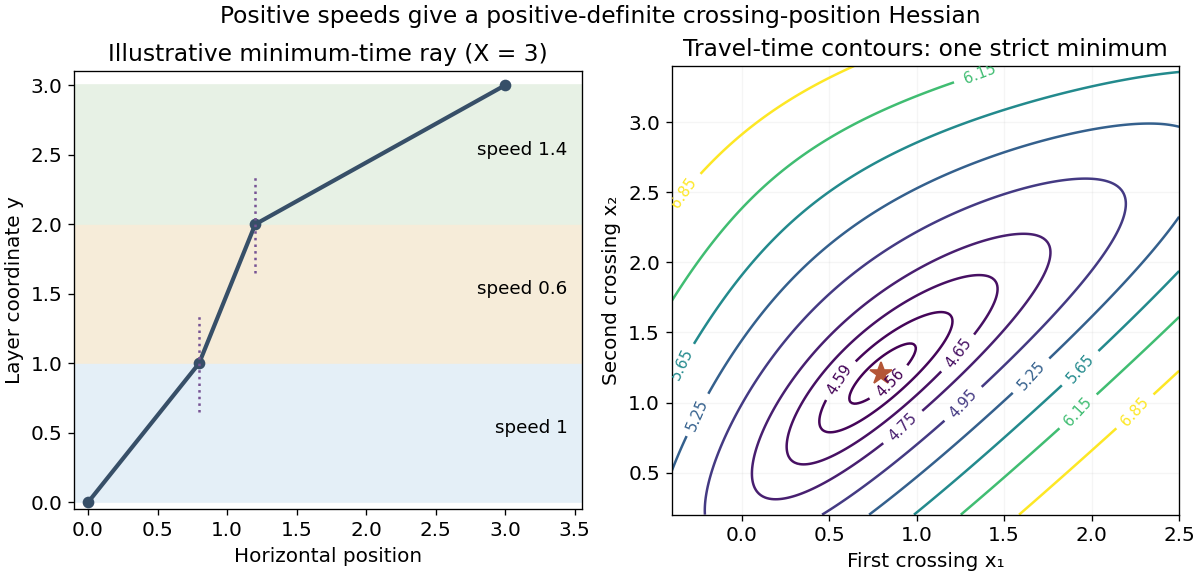
For the stated time function, putPositive physical speeds make all three coefficients positive. The positive Hessian of a layered travel-time functional here isThus the stationary path is a strict minimum, not merely a candidate of unspecified type. In fact the same positivity holds for all finite crossing positions, so the time function is strictly convex and the minimum is unique.

New to topics? Read the docs here!