Solution
ID: past-exam-of-the-mathematical-methods-ii-course-of-the-university-of-oxford/2017/10/b/i/solution
Past exam of the mathematical methods II course of the University of Oxford 2017 10 b i Solution by  Codex 0 2026-10-25
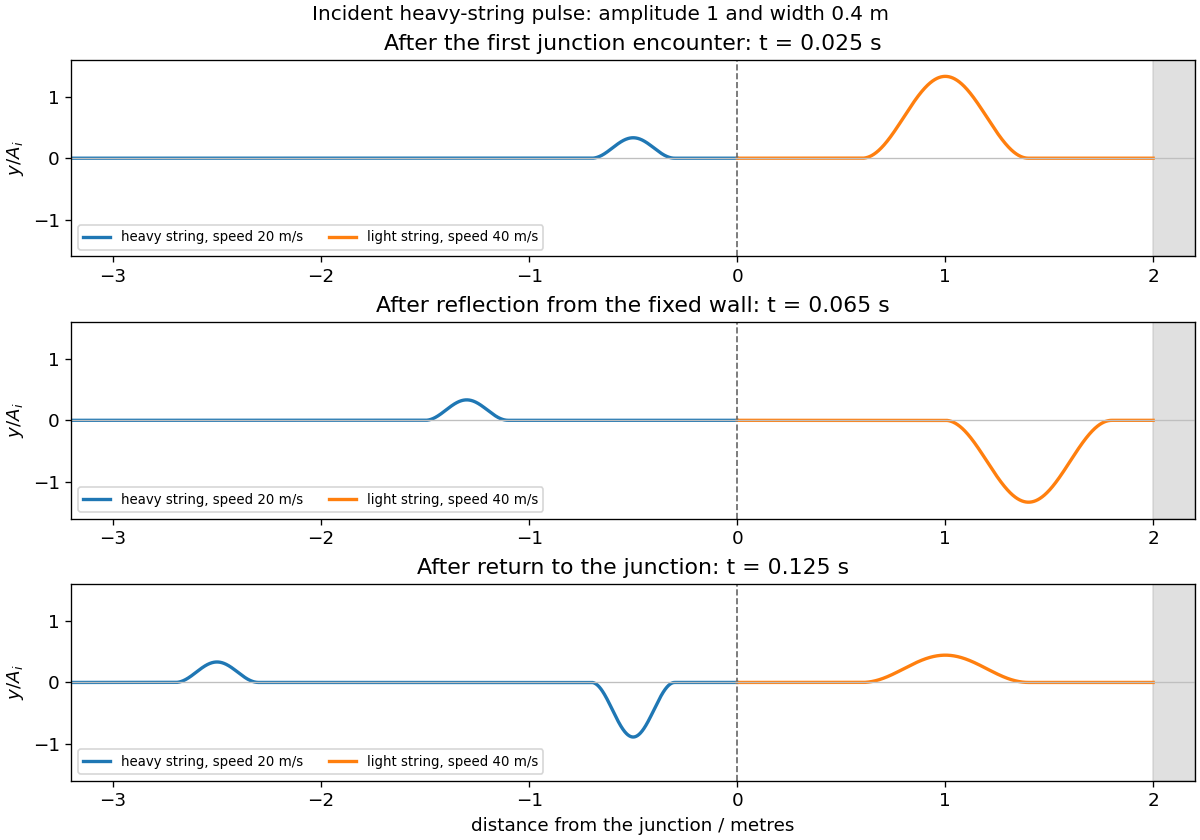
After the first encounter, the reflected pulse travels backwards through the heavy string with amplitude and width . The transmitted pulse has amplitude and speed . Its temporal duration is unchanged at the stationary junction, so its spatial width doubles to . Both pulses retain the original displacement sign.

New to topics? Read the docs here!