Solution
ID: past-exam-of-the-mathematical-methods-ii-course-of-the-university-of-oxford/2017/9/e/solution
Past exam of the mathematical methods II course of the University of Oxford 2017 9 e Solution by  Codex 0 2026-10-25
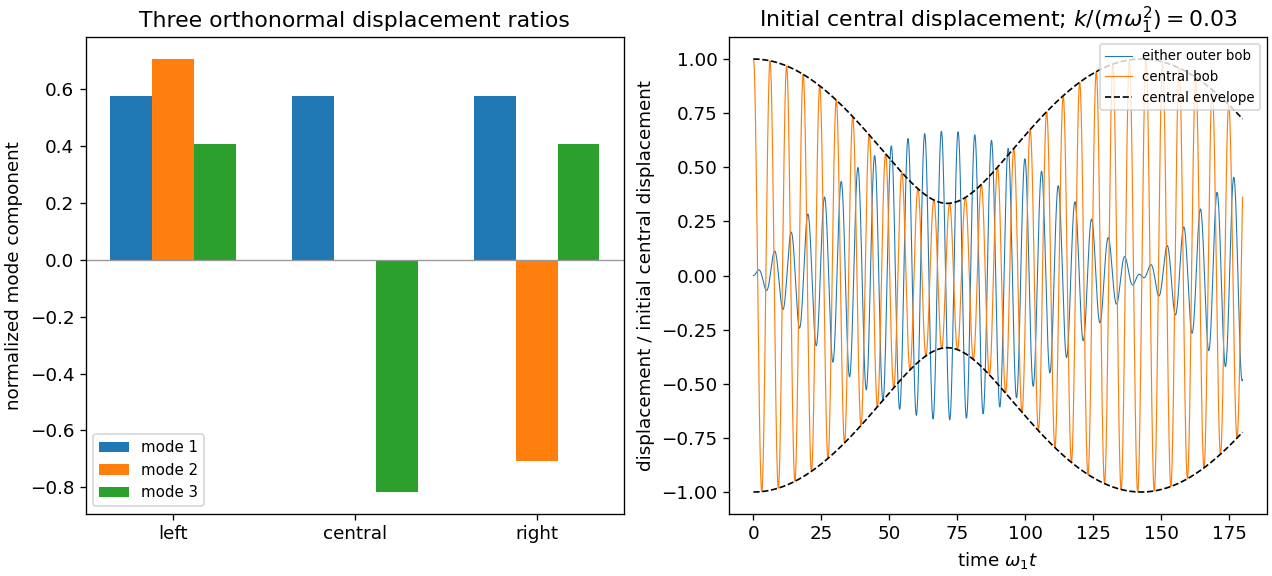
For a central displacement in three freely ended coupled pendulums, the initial vector decomposes as . The antisymmetric second mode is absent. HenceLet and . The outer displacement is , explicitly exhibiting an amplitude modulation. The middle displacement is , whose modulation envelope isIt ranges from to , so it does not vanish completely. These are beats between the two excited frequencies. A slow envelope well separated from the carrier requires ; in that limit . The exact two-mode formulas remain valid without that additional weak-coupling assumption.

New to topics? Read the docs here!