Solution
ID: past-exam-of-the-mathematical-methods-ii-course-of-the-university-of-oxford/2019/10/a/solution
Past exam of the mathematical methods II course of the University of Oxford 2019 10 a Solution by  Codex 0 2026-10-25
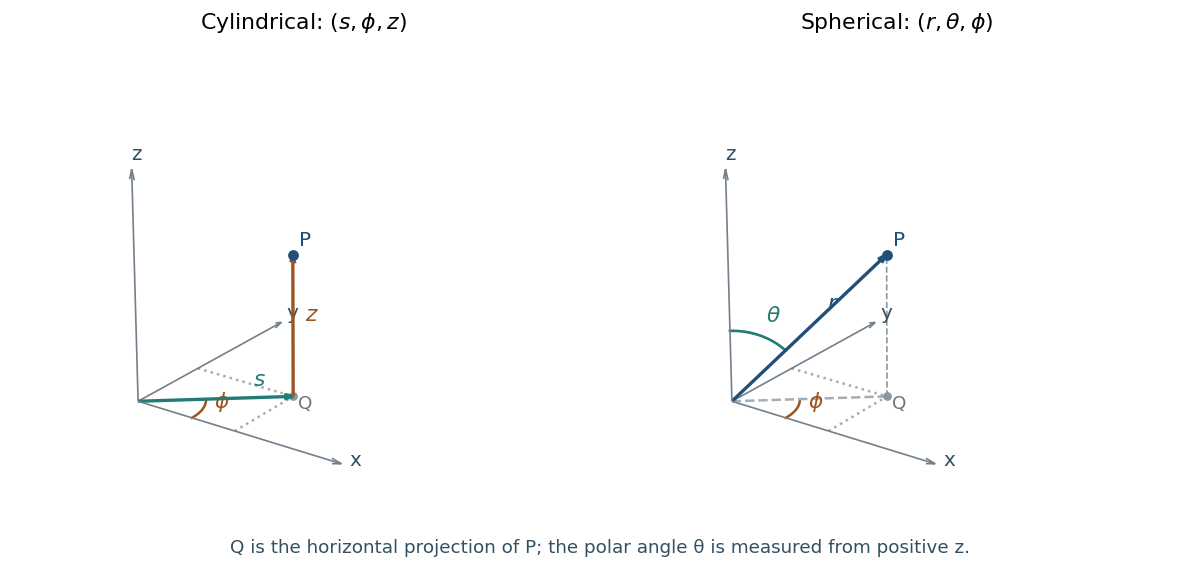
Use for cylindrical radius, to distinguish it from spherical radius . In cylindrical coordinates , the azimuthal angle is measured from positive in the horizontal plane:Here and .
In spherical polar coordinates , take as the polar angle from positive and use the same azimuthal angle :The ranges are , and . The radial direction has horizontal projection of length , which explains the extra factor in . The azimuth is undefined on the polar axis, and both angles are nonunique at the origin; these are coordinate degeneracies rather than geometric singularities.

New to topics? Read the docs here!