Solution
ID: past-exam-of-the-mathematical-physiology-course-of-the-university-of-oxford/2011/3/b/solution
Past exam of the mathematical physiology course of the University of Oxford 2011 3 b Solution by  Codex 0 2026-10-31
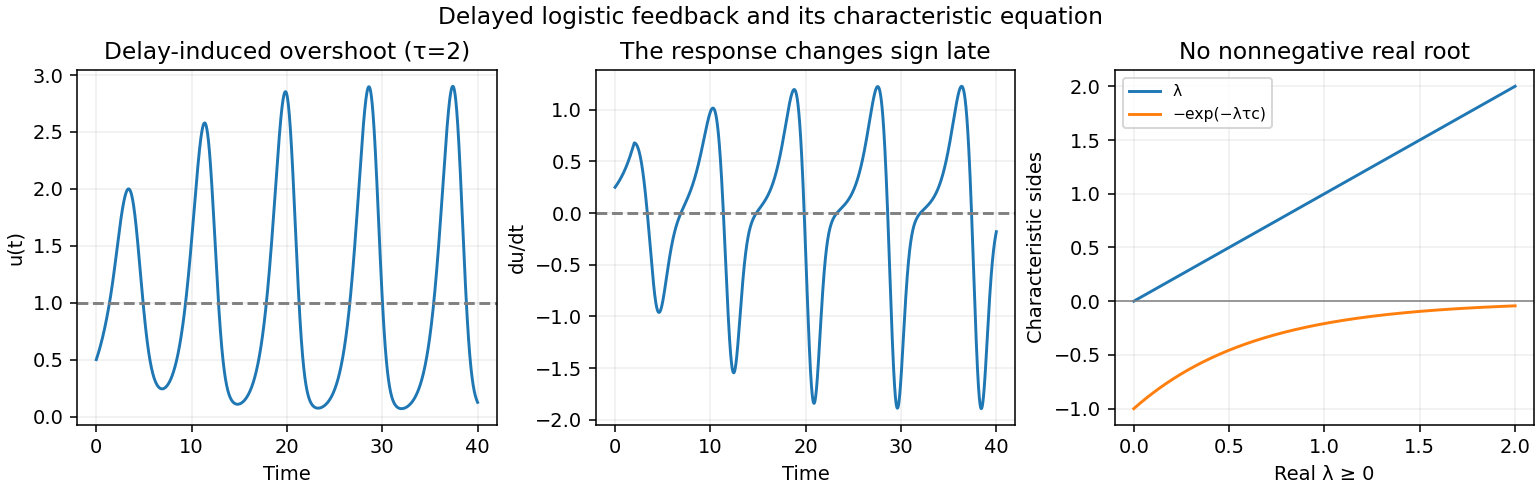
A positive solution stays positive, sinceTherefore the sign of is exactly the sign of . Initially the given history below one makes . If crosses one upwards at time , it continues growing until , because the feedback still sees earlier values below one. It reaches a maximum when the delayed value crosses one. Similarly, after a downward crossing at , it continues decreasing until and reaches a minimum then.
This delayed reversal makes overshoots and undershoots possible. In a derivative sketch, positive lobes persist until one delay after upward crossings, followed by negative lobes persisting until one delay after downward crossings. Sustained oscillation depends on the delay; a short delay can instead give convergence to one. The example shown has and a history identically .

New to topics? Read the docs here!