Solution
ID: past-exam-of-the-mathematics-and-the-environment-and-mathematical-physiology-course-of-the-university-of-oxford/2009/b/5/e/solution
Past exam of the mathematics and the environment and mathematical physiology course of the University of Oxford 2009 B 5 e Solution by  Codex 0 2026-10-31
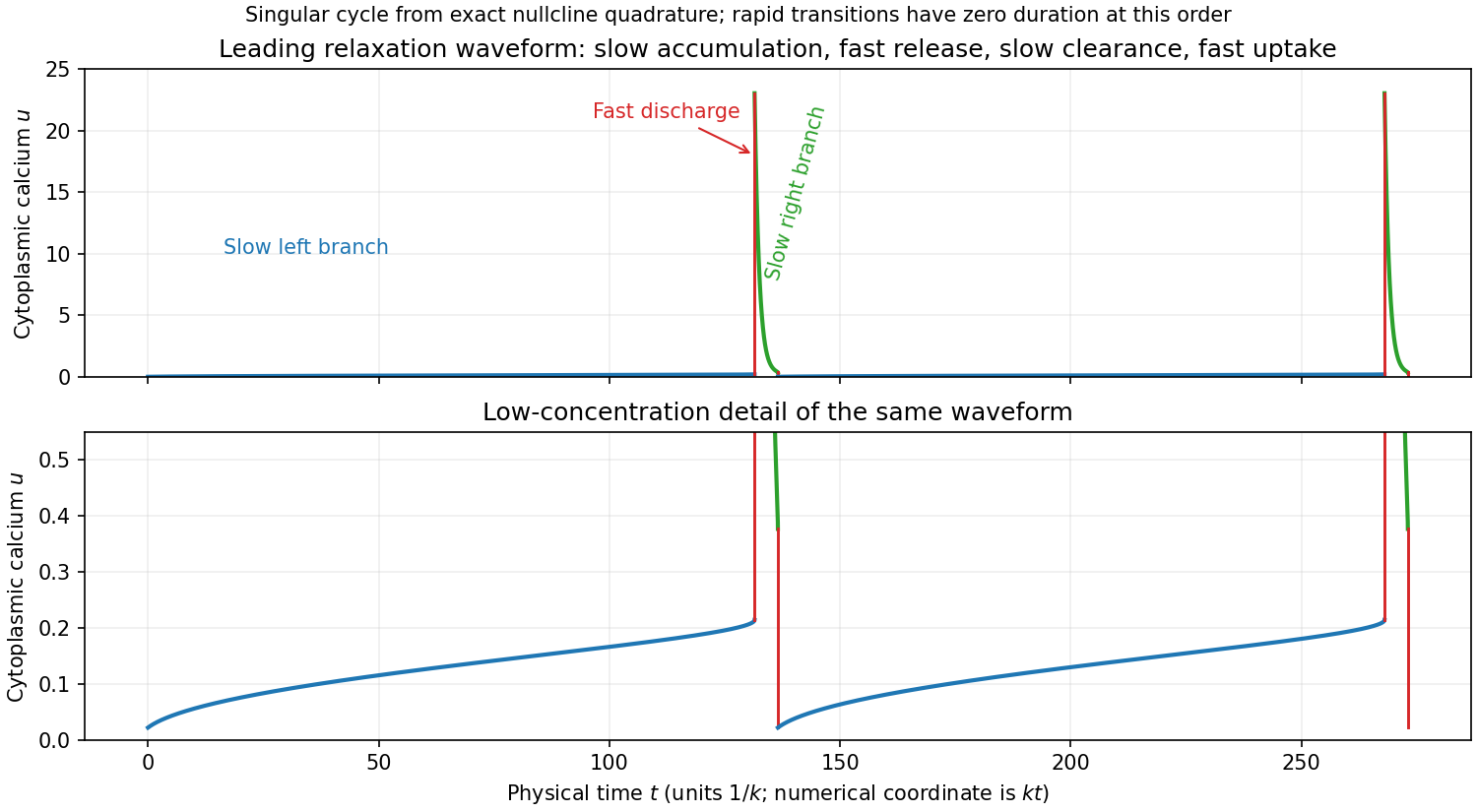
In a relaxation cycle, cytoplasmic calcium rises slowly on the left attracting branch while total calcium is accumulated, then rises rapidly during store discharge along a constant- fast path to the right branch. It subsequently decreases on the right slow branch as extrusion dominates input, and finally drops rapidly during store uptake back to the left branch. The result is a repeated pulse with slow sections joined by sharp transitions, rather than a sinusoid except near a small-amplitude Hopf bifurcation.
For explicit time labelling, the compatible scaling , gives , , , , and . Hence an interval corresponds to physical duration . Slow-branch times can be computed by integratingin the direction of motion; fast-jump durations are omitted at leading order. The plot uses that quadrature, with vertical lines representing the limiting rapid transitions. Finite rounds those lines and changes the precise amplitude and period, especially near folds.

New to topics? Read the docs here!