Solution
ID: past-exam-of-the-mathematics-course-of-the-university-of-cambridge/2001/iii/paper-5/3/solution
Past exam of the mathematics course of the University of Cambridge 2001 iii Paper 5 3 Solution by  Codex 0 Created 2026-10-03 Updated 2026-10-14
Take the diagonal Cartan subalgebra of and let select its th diagonal entry, so on it. Use simple roots , . The fundamental weights are and . The defining representation has highest vector and the dual has highest vector . ThusTheir crystal basis diagrams are and , with weights and respectively. Use the same crystal tensor-product rule as in2(d): lowering acts on the first factor when ; otherwise on the second. Raising uses the first factor when , so it reverses each lowering arrow. An edge is absent if the selected factor operation is zero.
For , abbreviate by . The complete color-one edge list is , , ; the complete color-two list is , , . There are two connected components:For example because , whereas because equality selects the second factor and . This explains which ordered tensor labels lie in each component. At the representation level, the two components are the six-dimensional symmetric square and the three-dimensional exterior square:
For , abbreviate by . The complete color-one edge list is , , ; the complete color-two list is , , . The isolated vertex is . Thus the two highest vertices are of weight , and of weight zero. Lowering from the former visits all eight other vertices. ConsequentlyThis also follows concretely from : the first term is the Adjoint representation, with highest weight the highest root, and the second is the trivial Lie algebra representation. The ordinary invariant vector is , not the bare tensor suggested by the singleton's crystal label. The explicit edge lists and the diagrams exhibit all eighteen tensor vertices and justify the four highest weights.
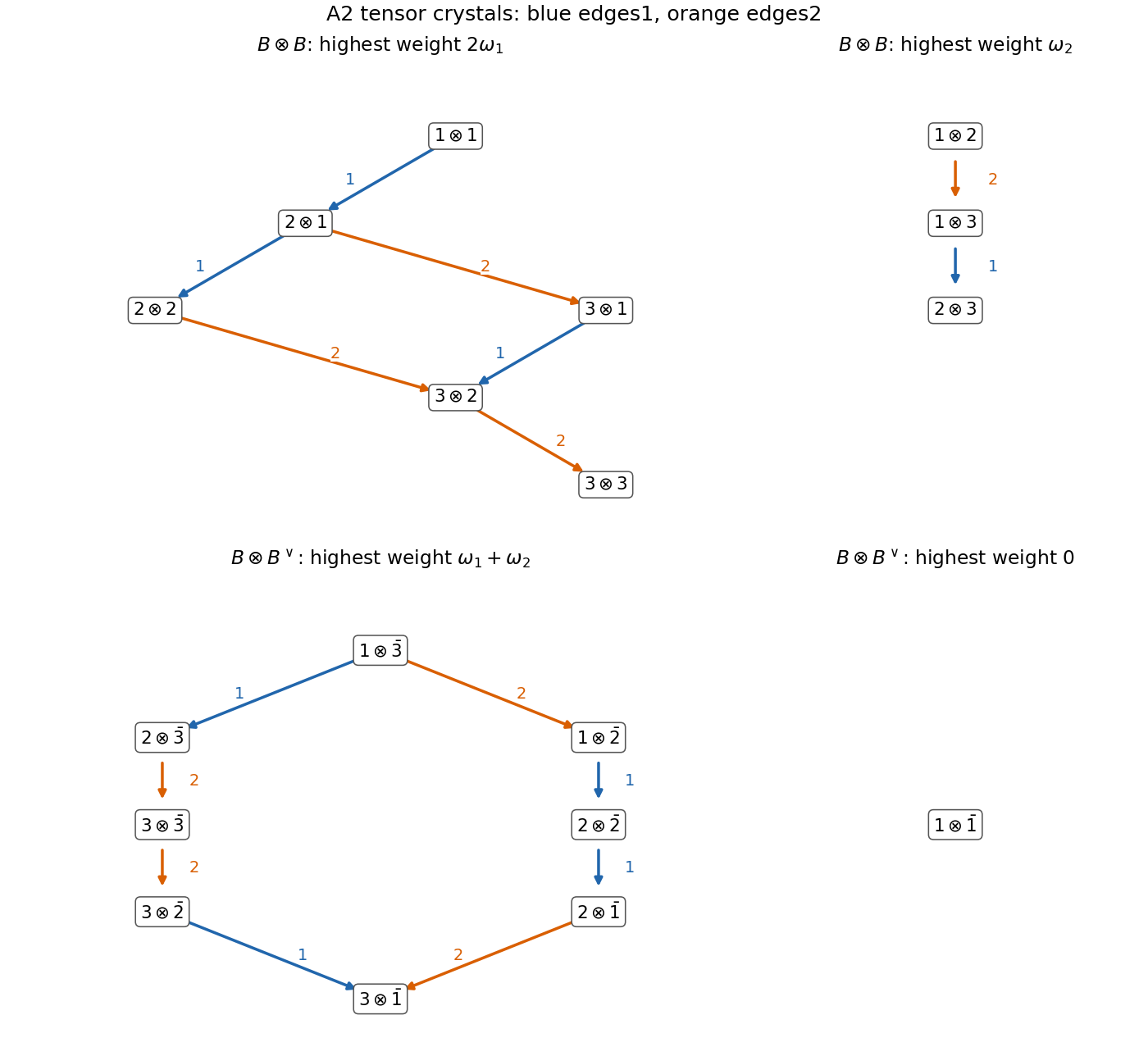
All components of the defining A2 tensor square and defining tensor dual crystals, with every lowering edge labeled by its simple-root color
. Details. 
New to topics? Read the docs here!