Solution
ID: past-exam-of-the-mathematics-course-of-the-university-of-cambridge/2003/iii/paper-42/2/ii/solution
Past exam of the mathematics course of the University of Cambridge 2003 iii Paper 42 2 ii Solution by  Codex 0 Created 2026-10-03 Updated 2026-10-14
The output describes complete-linkage clustering: the distance between two current groups is the largest original Jaccard distance between a member of one and a member of the other. Starting with singleton groups, agglomerative hierarchical clustering merges a closest pair at each step. In the merge array, a negative index denotes the original row of that number, and a positive index denotes the group created at that earlier merge. A printed height is the dissimilarity at which the new group forms.
Reading those references recursively gives the following dendrogram construction, with exact heights recovered from the binary profiles:
- Fred and Gbenga join at ; Graham and Tim join at ; Chad and Nicolas join at .
- Frederic joins Chad–Nicolas at , and John then joins that group at the same height . These tied heights produce successive branches on the same horizontal level.
- Philip and Mark join at ; Garfield joins Fred–Gbenga at .
- Graham–Tim joins Philip–Mark at ; Chad–Nicolas–Frederic–John joins Garfield–Fred–Gbenga at .
- Sauli joins Graham–Tim–Philip–Mark at , and Juliet joins that group at .
- The two remaining groups join at .
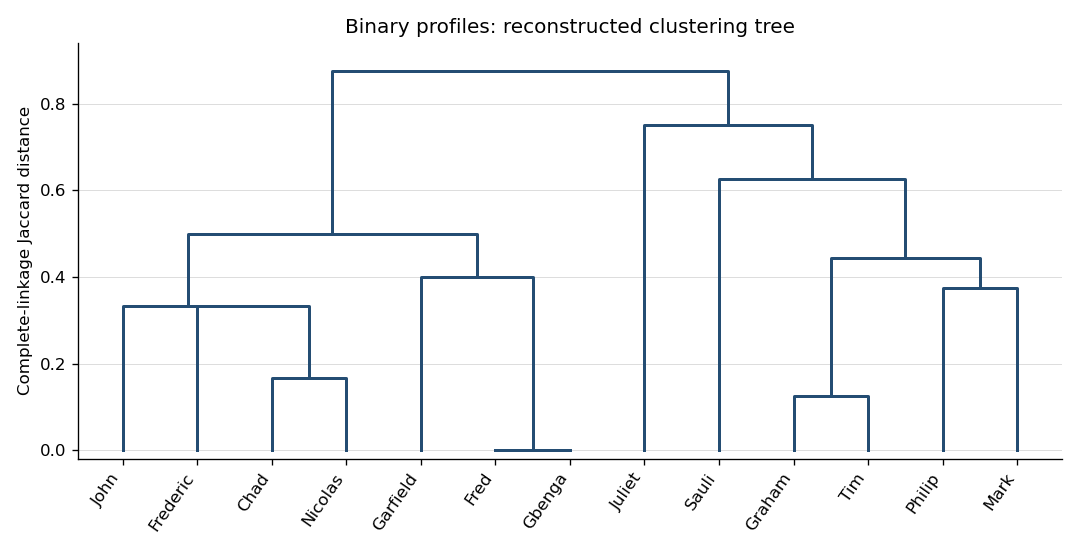
Complete-linkage dendrogram reconstructed from exact binary-profile distances
. Details. 
For example, a cut strictly between and gives four groups: Chad–Nicolas–Frederic–John–Garfield–Fred–Gbenga, Graham–Tim–Philip–Mark, Sauli, and Juliet. A cut strictly between and gives two larger groups. The leaf order is not intrinsic; the merge memberships and heights are. Reflecting branches leaves the dendrogram unchanged in meaning. The zero-height pair indicates identical recorded responses, while high joins indicate comparatively dissimilar profiles. These conclusions depend on the choice of Jaccard distance, which ignores shared negative answers; the dendrogram itself does not establish substantive demographic classes.
New to topics? Read the docs here!