Solution
ID: past-exam-of-the-mathematics-course-of-the-university-of-cambridge/2003/iii/paper-58/5/b/solution
Past exam of the mathematics course of the University of Cambridge 2003 iii Paper 58 5 b Solution by  Codex 0 Created 2026-10-03 Updated 2026-10-14
The positive conformal factor leaves the causal structure unchanged. In the strip , a future-directed causal curve obeysand null geodesics have slopes . Its past and future conformal boundaries are spacelike. A finite conformal time interval limits the range of light signals: the observer at can receive a signal from before future infinity exactly when . Equality describes its observer-dependent cosmological event horizon.
For a finite Penrose diagram of the unwrapped spatial coordinate, set , , , and . Then the metric is conformal to ; light rays remain at degrees, and the boundaries are the images of . The figure also shows the spatially periodic de Sitter cylinder so that the global distinction is explicit.
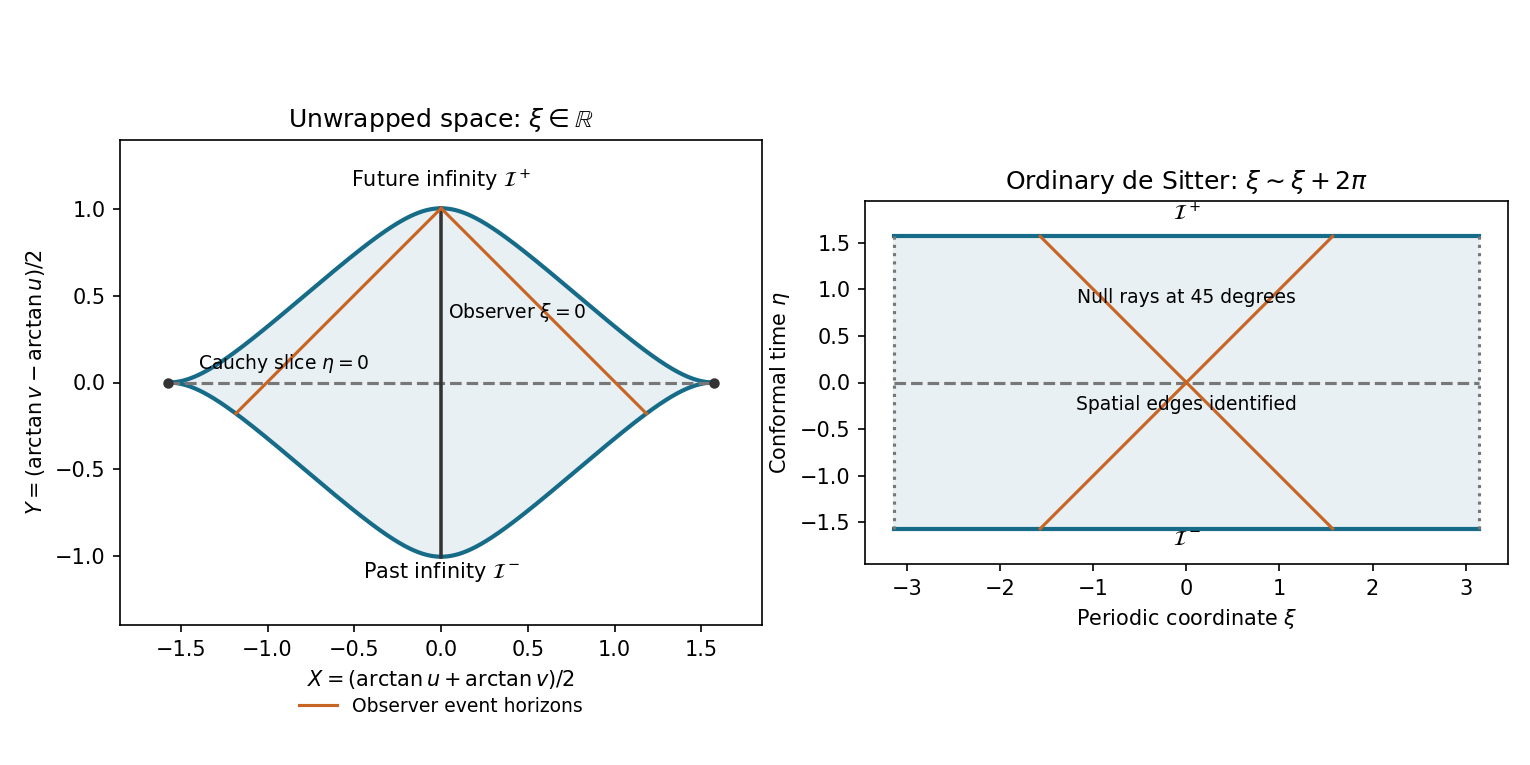
Causal compactification of the unwrapped de Sitter strip and the spatially periodic de Sitter cylinder
. Details. 
Both the covering spacetime and the de Sitter cylinder are globally hyperbolic. To see this directly in the covering spacetime, suppose an inextendible future-directed causal curve had a future limiting conformal time strictly below . The slope bound makes Cauchy as that time is approached, so the curve has a limiting point inside the spacetime and can be extended, a contradiction. The past endpoint similarly approaches . Thus every constant- line is crossed exactly once and is a Cauchy hypersurface. On the cylinder the same argument uses compactness of the spatial circle. Equivalently causal diamonds between finite events are bounded and closed within the strip, hence compact.
Initial field data on a complete Cauchy hypersurface determine a unique solution for a well-posed hyperbolic Cauchy problem, with the relevant constraints imposed for constrained systems. Spacelike conformal infinity does not require additional timelike-boundary conditions. An observer's cosmological horizon limits which data that observer can see; it does not destroy global uniqueness from data on the whole hypersurface.
New to topics? Read the docs here!