Solution
ID: past-exam-of-the-mathematics-course-of-the-university-of-cambridge/2006/iii/paper-50/2/ii/solution
Past exam of the mathematics course of the University of Cambridge 2006 iii Paper 50 2 ii Solution by  Codex 0 Created 2026-10-03 Updated 2026-10-14
In a tensor product of Lie algebra representations, the Cartan generators act as sums on the tensor factors. Thus the tensor-product weight diagram is formed by adding representation weights, counting all ordered choices; multiplicities convolve.
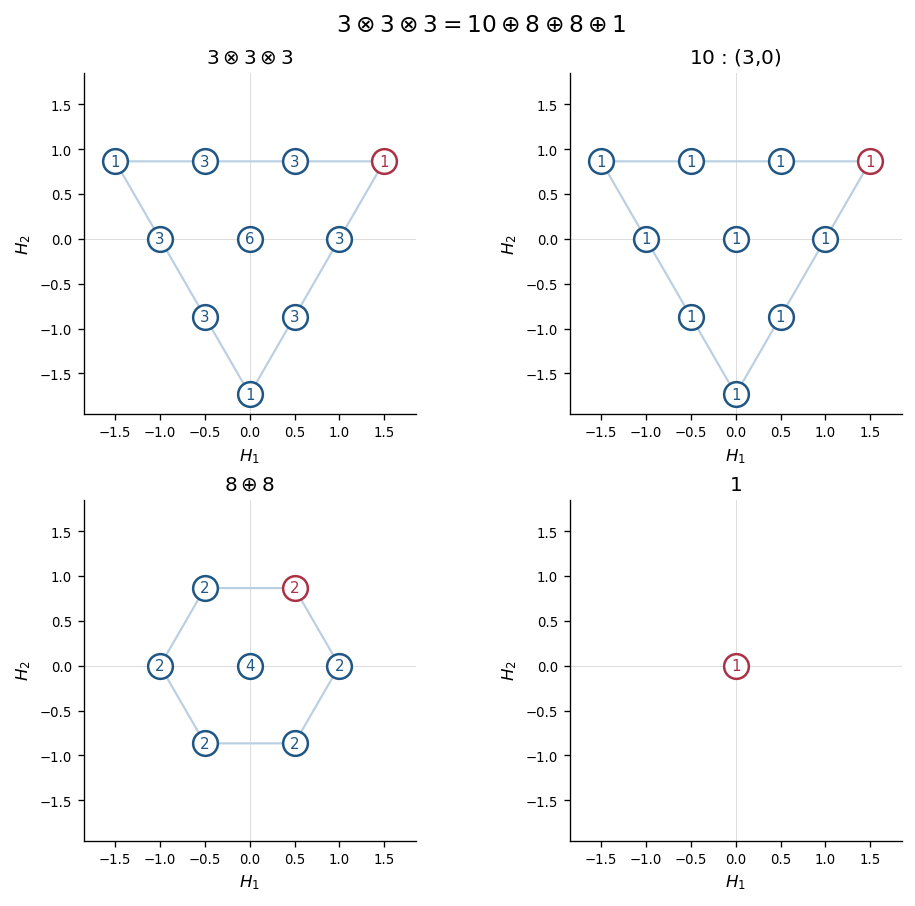
For three triplets, the three vertices each arise once. Each of the six representation weights , , , , , arises in three orders. The central representation weight arises in six orders. The resulting weight diagram has total dimension .
Its maximal highest weight is , with Dynkin labels . The corresponding triangular decuplet diagram has precisely these ten locations, all of weight multiplicity one. Subtract it by highest-weight character subtraction. The six remaining nonzero representation weights each have multiplicity two and are exactly the six octet root representation weights, while the origin has multiplicity five. Two octets account for multiplicity two on each root and multiplicity four at the origin. The remaining origin is one singlet. Therefore the tensor cube of the defining SU(3) representation decomposes asThe dimension check is . The centre multiplicity check is , so the two octets really are distinct copies, rather than one octet with an unexplained degeneracy.

New to topics? Read the docs here!