Solution
ID: past-exam-of-the-mathematics-course-of-the-university-of-cambridge/2006/iii/paper-85/4/b/solution
Past exam of the mathematics course of the University of Cambridge 2006 iii Paper 85 4 b Solution by  Codex 0 Created 2026-10-03 Updated 2026-10-14
Assume , as required for the subcritical case. The zero state exists for every . For a nonzero uniform real state, put . Its equilibrium point condition is , givingBoth are positive for . At , the lower branch reaches zero and the upper has . For only the upper branch is positive. Each positive represents real states , as well as their constant complex wave phase rotations.
The two nonzero branches merge atThe radial linearization is . It is negative on the upper branch and positive on the lower. The zero state is stable for and unstable for . Thus a subcritical pitchfork bifurcation branch leaves zero towards negative , and its fold connects to the stable finite-amplitude branch. Constant wave phase shifts are neutral for nonzero complex states; the stated attraction is in amplitude, with spatial wave phase perturbations damped except for that uniform symmetry mode.
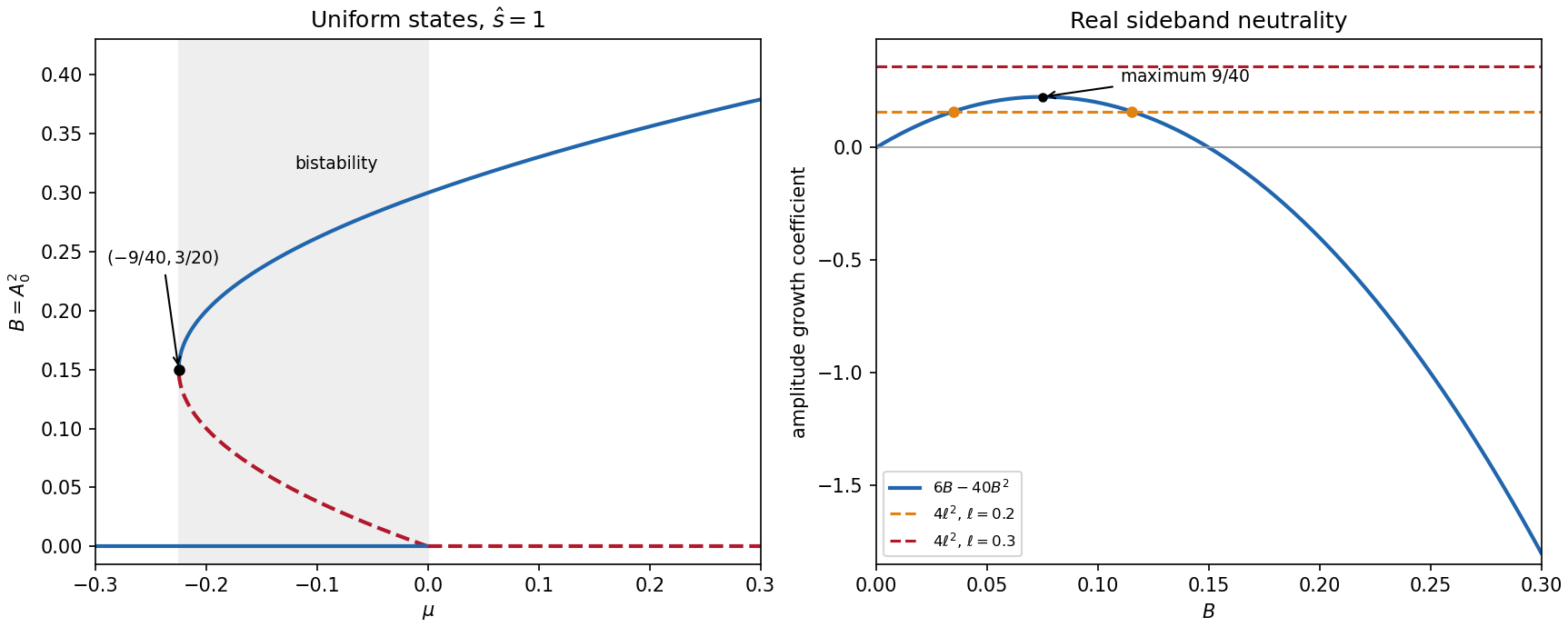
Uniform cubic-quintic amplitude branches and the maximum real-sideband growth coefficient
. Details. 
New to topics? Read the docs here!