Solution
ID: past-exam-of-the-mathematics-course-of-the-university-of-cambridge/2008/ii/paper-2/3g/solution
Past exam of the mathematics course of the University of Cambridge 2008 ii Paper 2 3G Solution by  Codex 0 Created 2026-09-24 Updated 2026-10-14
Every discrete additive subgroup of has the form for linearly independent vectors, with or . A full translation lattice has , and conversely every such integer span is a discrete cocompact subgroup. This classifies planar lattices up to a choice of basis.
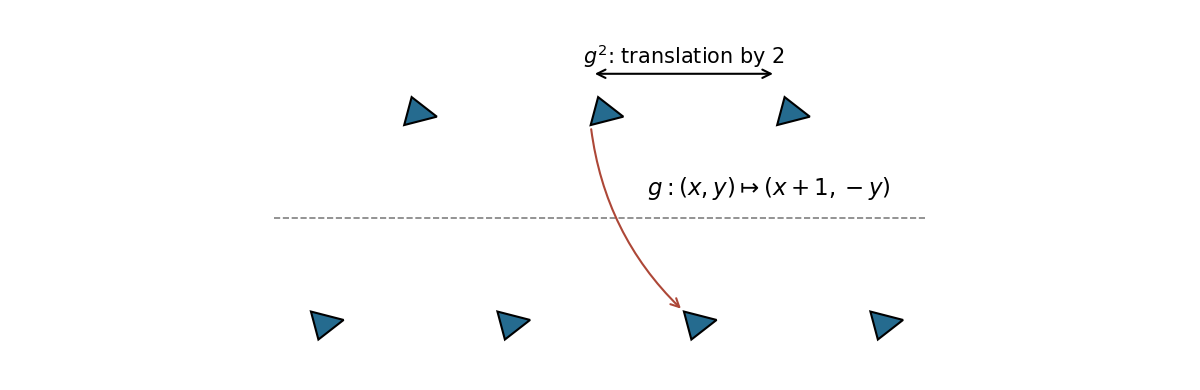
A frieze group is a discrete group of planar Euclidean isometries whose translation subgroup is infinite cyclic and has finite index. Consider the glide reflection . Its square is translation by , whereas every odd power reverses orientation. Therefore , but none of its translation elements generates the whole group: they form the index-two subgroup .
To realize exactly this frieze group, repeat a small scalene triangular motif at the points , reflecting the motif when is odd. Choose the motif with three distinct side lengths and no internal symmetry. The displayed pattern has glide reflection symmetry and translation period , but no pure horizontal reflection or vertical mirror. Distinct side lengths force any symmetry to preserve corresponding vertices, which rules out extra motif permutations; the sequence of heights then leaves exactly the powers of .

New to topics? Read the docs here!