Solution
ID: past-exam-of-the-mathematics-course-of-the-university-of-cambridge/2008/iii/paper-83/3/c/solution
Past exam of the mathematics course of the University of Cambridge 2008 iii Paper 83 3 c Solution by  Codex 0 Created 2026-10-03 Updated 2026-10-14
Set . The characteristic polynomial is , whose roots have arguments , , , and . Only the last two have negative real part and decay at infinity. Write and ; the admissible roots areThus . Since , the boundary equations are and . ThereforeTaking real parts gives the oscillatory bending of a moment-free semi-infinite filamentThe first phase is constant along paths with , so that contribution travels left. The second has and travels right. Both are forced, attenuating patterns in an overdamped medium; they are not undamped inertial waves. Their amplitudes are equal at the driven end, but gives decay lengths and . Hence the right-travelling contribution dominates away from the end, because it decays more slowly; its amplitude relative to the left-travelling one grows as .
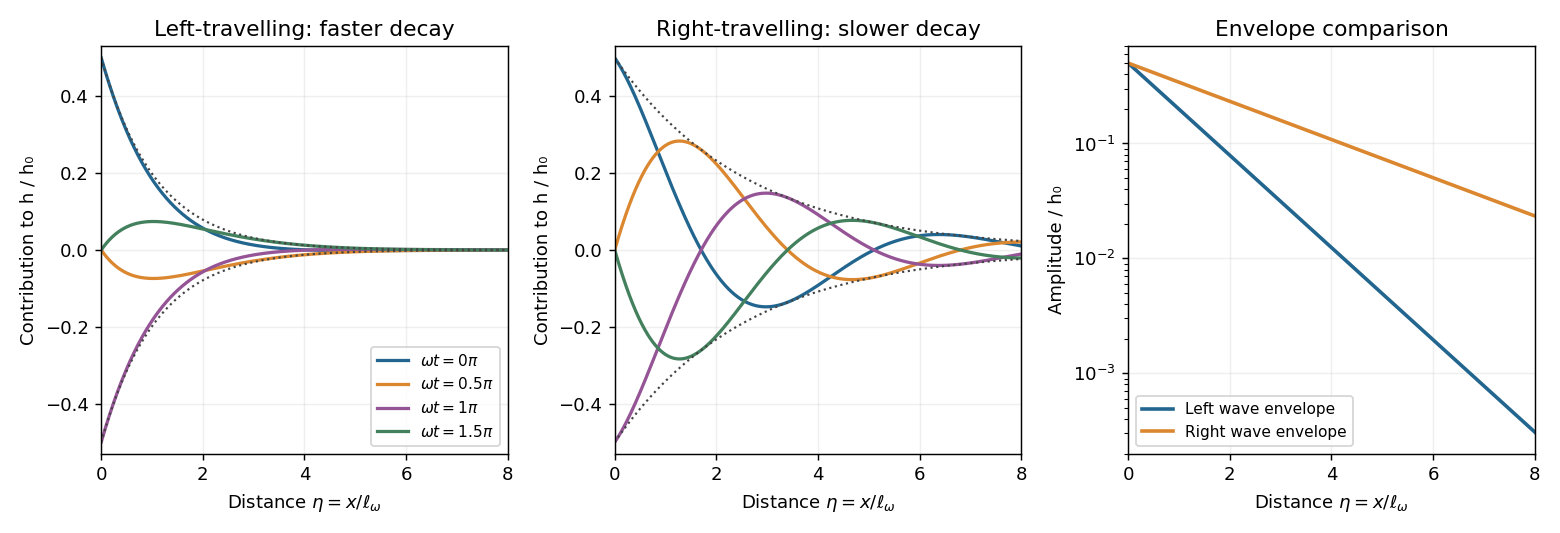
Counter-propagating contributions to a driven filament, with faster attenuation of the left-travelling wave
. Details. 
New to topics? Read the docs here!