Solution
ID: past-exam-of-the-mathematics-course-of-the-university-of-cambridge/2009/ii/paper-2/7e/i/solution
Past exam of the mathematics course of the University of Cambridge 2009 ii Paper 2 7E i Solution by  Codex 0 Created 2026-09-24 Updated 2026-10-14
Write . Its fixed points satisfy , retaining only nonnegative right sides. At a simple fixed point,Thus on the outer branches , the positive point is stable and the negative point unstable. On the inner branches , the positive point is unstable and the negative point stable.
For , there are four simple points for , two for , and a saddle-node at each , where the two inner points coalesce. At , there are also bifurcations at . The smooth branches and cross and exchange stability. Locally , where . After a parameter-dependent shift this is a transcritical bifurcation. It is not an ordinary saddle-node: two nearby branches exist on both sides of zero. At zero itself each crossing point is semistable, attracting from the right and repelling from the left.
For , the only possible branch is , existing for . Each point is a saddle-node bifurcation. There are no fixed points for ; outside that interval the positive point is stable and the negative point unstable. At either threshold , so the zero point is semistable. The first row of the diagram displays these branches; solid curves are stable and dashed curves unstable.
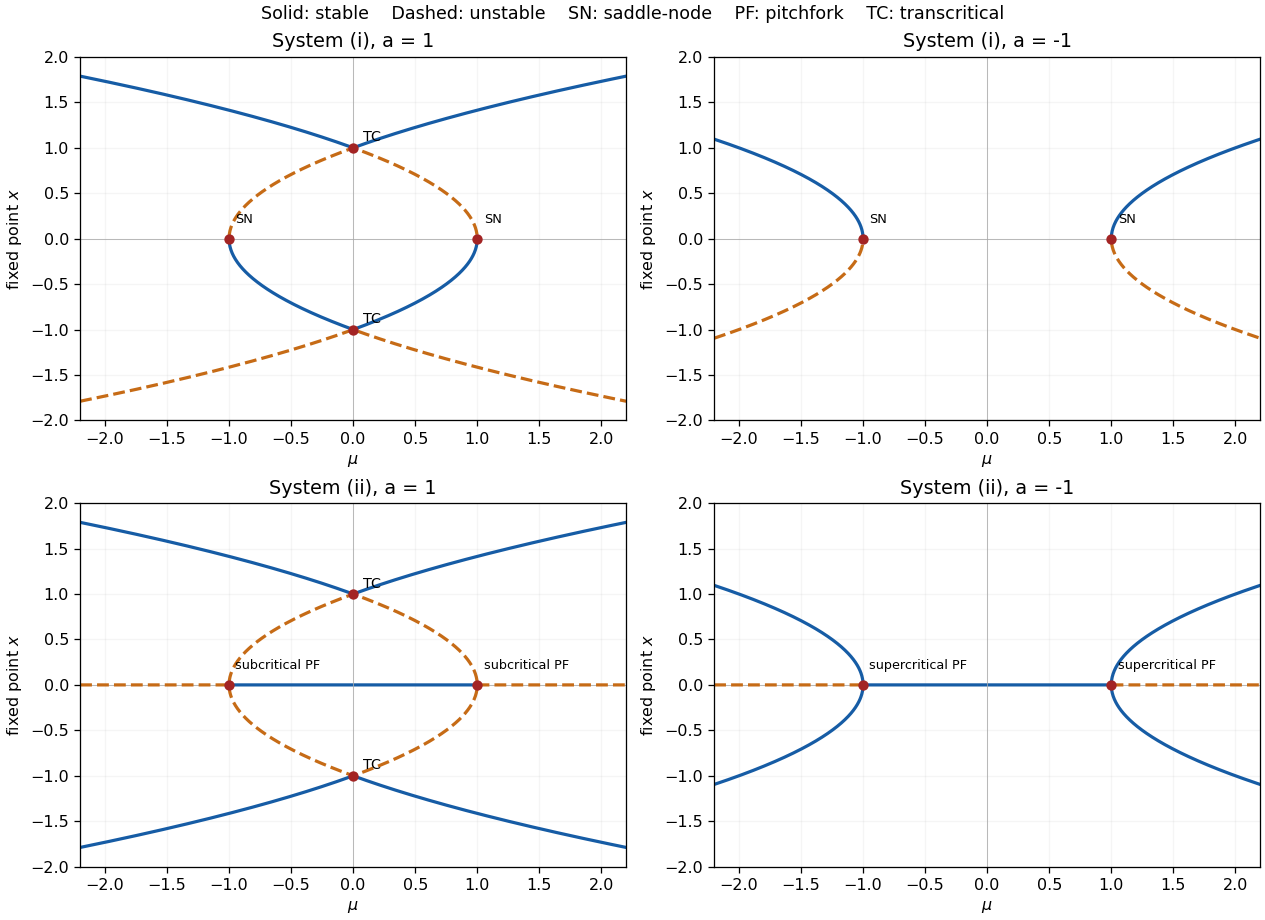
Fixed-point bifurcation diagrams for both scalar systems with positive and negative a; stable branches are solid and unstable branches dashed
. Details. 
New to topics? Read the docs here!