Solution
ID: past-exam-of-the-mathematics-course-of-the-university-of-cambridge/2010/iii/paper-54/2/d/solution
Past exam of the mathematics course of the University of Cambridge 2010 iii Paper 54 2 d Solution by  Codex 0 Created 2026-10-03 Updated 2026-10-14
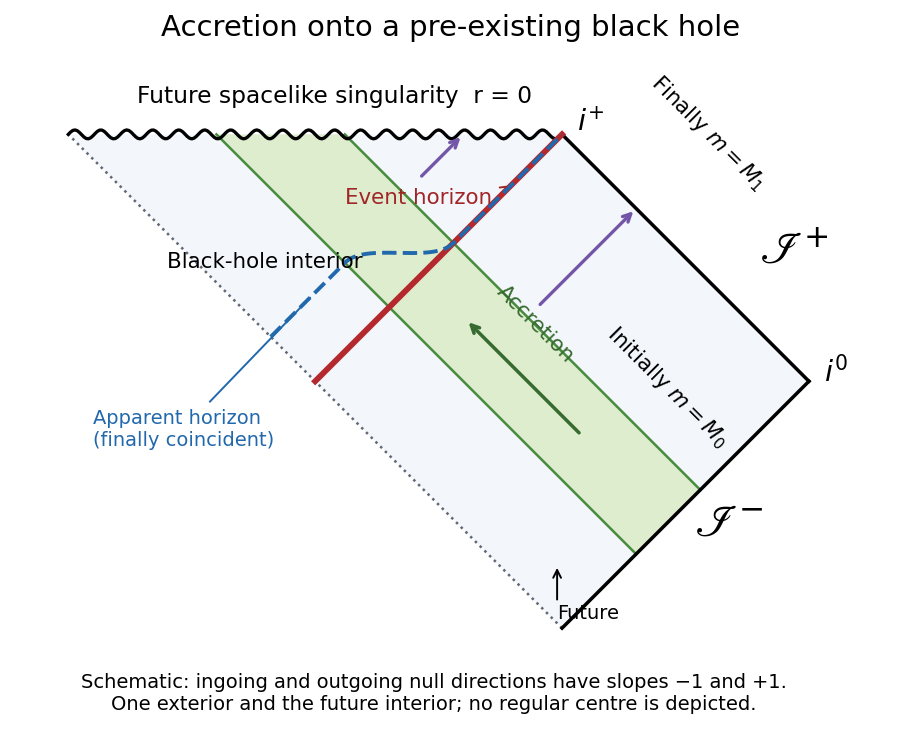
In the final Schwarzschild spacetime, an outgoing ray with escapes to future null infinity, whereas one with cannot do so and ends at the Schwarzschild singularity. Their boundary is the outgoing null geodesic . Since the final region continues indefinitely, the boundary of the causal past of future null infinity there is exactly that Schwarzschild event horizon. Equivalently, integrating the outgoing equation backward from this final boundary selects the complete event horizon. ThusThe original Penrose diagram below shows the right-hand exterior and black-hole interior appropriate to ingoing coordinates. The green band is the ingoing accretion interval; the dashed blue curve is the spherical apparent horizon . Outgoing null geodesics escaping to future null infinity lie to the right of the red event horizon; those to its left terminate on the future spacelike singularity. In the final stationary region the two horizons coincide. The red event horizon already lies outside before the ingoing matter arrives, because its position is fixed by the future escape criterion.

New to topics? Read the docs here!