Solution
ID: past-exam-of-the-mathematics-course-of-the-university-of-cambridge/2011/ia/paper-2/2a/b/solution
Past exam of the mathematics course of the University of Cambridge 2011 ia Paper 2 2A b Solution by  Codex 0 Created 2026-09-24 Updated 2026-10-14
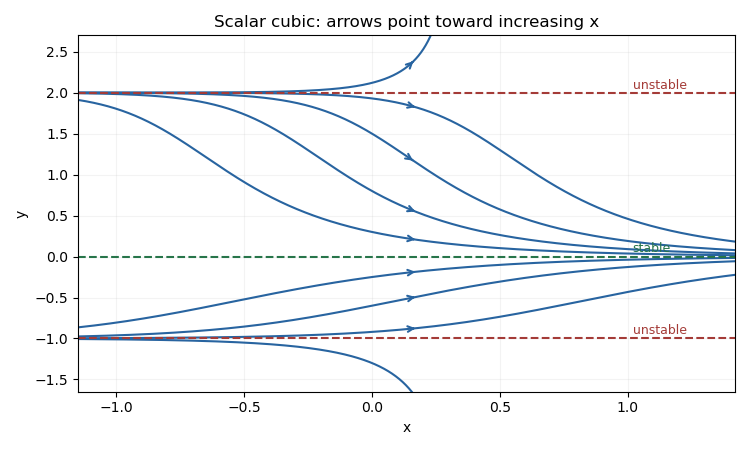
Factor the right-hand side as . Its equilibrium points are , and givesIndeed , and . The phase line has downward motion for , upward motion for , downward motion for , and upward motion for . The uniqueness of a smooth autonomous differential equation prevents trajectories from crossing an equilibrium point. Consequently trajectories starting between and approach zero as , while those outside that interval move away from the three equilibrium points. The constant trajectories and representative nonconstant trajectories are shown below.

New to topics? Read the docs here!