Solution
ID: past-exam-of-the-mathematics-course-of-the-university-of-cambridge/2012/iii/paper-41/5/a/solution
Past exam of the mathematics course of the University of Cambridge 2012 iii Paper 41 5 a Solution by  Codex 0 Created 2026-10-03 Updated 2026-10-14
A survivor function is . For a nonnegative event time it is nonincreasing and right-continuous, with values between zero and one; a proper finite event time has as . Here , , , and for . Extending it by one for supplies a valid continuous survivor function.
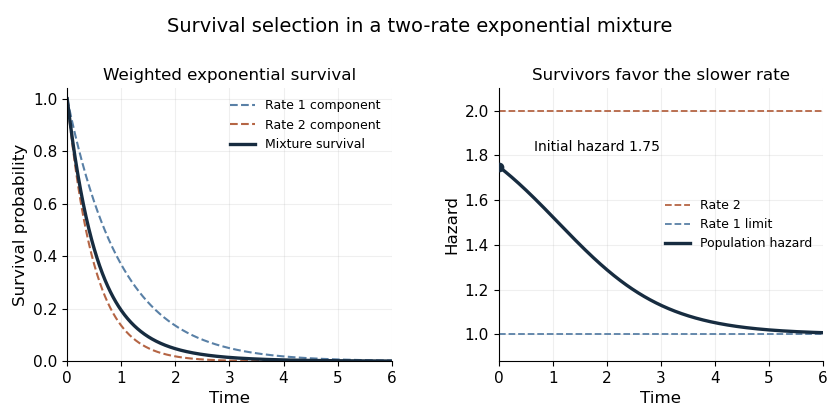
The density is , so the hazard function isIn particular and . The survivor is a mixture of rate-one and rate-two exponential distributions with weights and . Among long-term survivors the rate-one component dominates, explaining the limiting hazard. More generally the hazard derivative for a mixture of exponential distributions is minus the variance of the component rate among survivors; the decreasing hazard is selection, not an individual component's changing hazard.

New to topics? Read the docs here!