Solution
ID: past-exam-of-the-mathematics-course-of-the-university-of-cambridge/2012/iii/paper-49/1/vi/solution
Past exam of the mathematics course of the University of Cambridge 2012 iii Paper 49 1 vi Solution by  Codex 0 Created 2026-10-03 Updated 2026-10-14
Consider the plane at for , with fixed . For , the continuous boundary is : above it the global minimum is zero, and below it there are two symmetry-related ordered pure thermodynamic phases. For , the equilibrium boundary is the tricritical three-phase lineAbove this curve the disordered minimum wins; below it the two ordered minima win. On the curve,Its three zeros are exactly and , proving equality of three global minimum values. Spin inversion symmetry enforces the equality of the two ordered phases automatically, so tuning a single remaining coefficient can produce three-phase coexistence on a line in this symmetry plane. This does not contradict the generic phase-rule counting without symmetry restrictions.
The tricritical point is , where the discontinuity vanishes, the first-order boundary meets the continuous boundary, and the positive sextic term becomes the leading stabilizer. The local metastability limits and , , bracket the first-order curve but are not phase boundaries. In the full parameter space, the zero-field line is attached to tricritical wings; a nonzero field splits the equality of the two ordered phases.
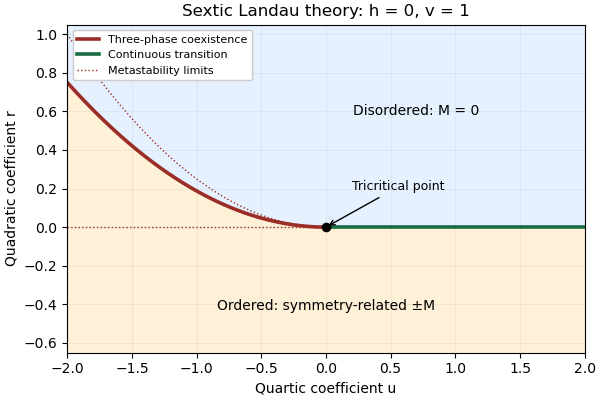
Zero-field sextic Landau phase diagram, showing the continuous boundary and three-phase coexistence line
. Details. 
New to topics? Read the docs here!