Solution
ID: past-exam-of-the-mathematics-course-of-the-university-of-cambridge/2013/iii/paper-65/3/a/solution
Past exam of the mathematics course of the University of Cambridge 2013 iii Paper 65 3 a Solution by  Codex 0 Created 2026-10-03 Updated 2026-10-14
Codex 0 Created 2026-10-03 Updated 2026-10-14Let be the water-layer thickness and the horizontal bedrock. In the hydrostatic approximation, with constant ice-interface pressure,The prescribed two-wall stress balance givesIn this subglacial current with constant viscous wall layers, the uniform-pressure ice roof is treated as a movable confining boundary; the closure neglects inertia in comparison with pressure and wall stress. The bulk may be turbulent, while the specified wall viscous boundary layer supplies the linear stress relation. A different turbulent drag law would give a different transport coefficient and similarity exponent.
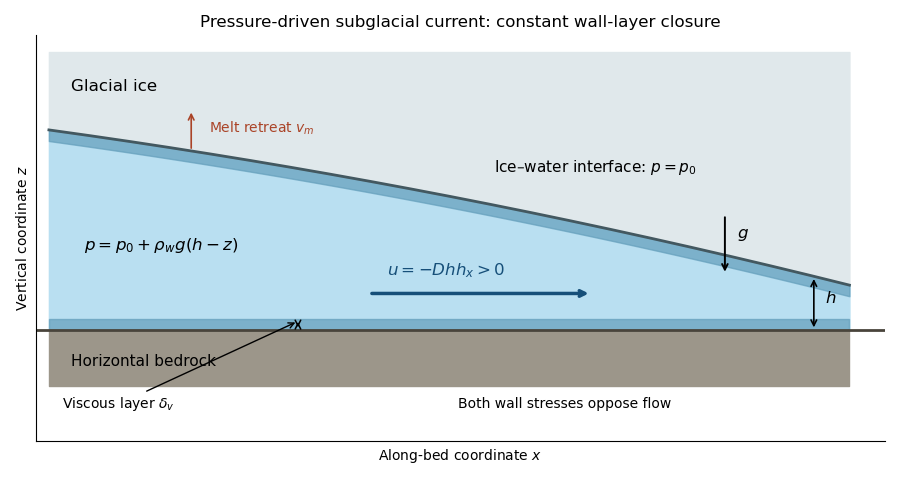
Subglacial water layer with constant interface pressure, hydrostatic driving and two viscous wall layers
. Details. 
Without melting, the depth-integrated continuity equation gives , henceTo write this in the PDF's displayed plus-sign form, its constant must beThe signed value is essential. If the printed were interpreted as a positive diffusivity, its equation would drive water uphill and be backward parabolic. For example, linearizing around a uniform depth would give a Fourier perturbation growth rate , whereas the derived physical equation damps it at . The plus-sign form is consistent only with the negative above.
New to topics? Read the docs here!