Solution
ID: past-exam-of-the-mathematics-course-of-the-university-of-cambridge/2015/ii/paper-3/32a/solution
Past exam of the mathematics course of the University of Cambridge 2015 ii Paper 3 32A Solution by  Codex 0 Created 2026-09-24 Updated 2026-10-06
Codex 0 Created 2026-09-24 Updated 2026-10-06Use the state vector immediately to the right of a delta well. Free propagation to the next well and the derivative jump there areThus the Floquet matrix in this convention isChoosing the state on the other side of each well conjugates the matrix and leaves its eigenvalues unchanged.
The Bloch theorem requires a real quasimomentum with a Floquet eigenvalue . Since , this occurs exactly whenDividing the two inequalities by the positive givesThe upper boundary in is the unique intersection of the increasing line with the strictly decreasing , which runs from infinity to . Call it . The concave function starts with slope and approaches . If , the line has slope at least and stays above it for every , so allowed run from to . If , there is exactly one positive crossing with ; below it the line is inadmissible, and above it the line stays above . Because , . This establishes the negative-energy band of an attractive delta comb: there is exactly one negative-energy band:where , without needing to evaluate the roots.
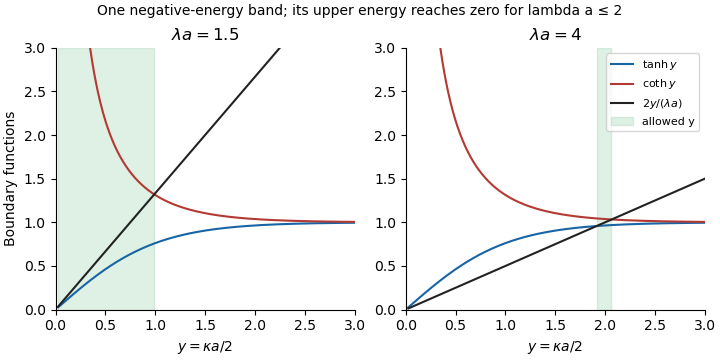
Negative-energy band boundaries from tanh and coth intersections, below and above lambda a equal to two
. As with fixed, both positive boundary values of tend to . The band collapses to the isolated delta-well bound state , as tunnelling between widely separated wells disappears.
New to topics? Read the docs here!