Solution
ID: past-exam-of-the-mathematics-course-of-the-university-of-cambridge/2015/iii/paper-38/3/b/solution
Past exam of the mathematics course of the University of Cambridge 2015 iii Paper 38 3 b Solution by  Codex 0 Created 2026-10-03 Updated 2026-10-14
Codex 0 Created 2026-10-03 Updated 2026-10-14On the dashed spanning tree, the nonzero flows arewith and all non-tree flows zero. The tree balances give supply four at vertex , demands one at and , and demand two at . Its cost is .
Choose and make the tree network reduced costs zero. The resulting network dual potentials areFor the non-tree edges, in the order , the network reduced costs areOnly has negative network reduced cost, so it enters the basis.
Adding this edge to the tree creates the graph cycle . Increasing its flow by adds on and subtracts on . These signed changes preserve every flow balance. The simplex ratio test allows , and the objective decreases by because the cycle's signed cost is .
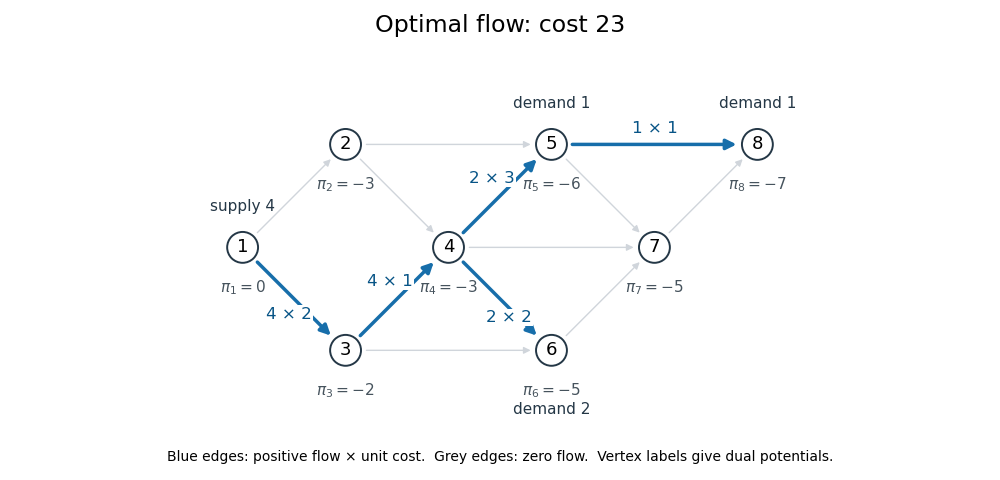
Take and remove from the basis. The other tied edge remains a zero-flow basic edge; this is a legitimate degenerate tree basis and requires no extra pivot. The new flow isIts cost is . For the new tree, chooseEvery network reduced cost is nonnegative: the new non-tree costs for are . All positive-flow edges have zero network reduced cost, and the dual objective is . Thus complementary slackness gives

New to topics? Read the docs here!