Solution
ID: past-exam-of-the-mathematics-course-of-the-university-of-cambridge/2015/iii/paper-59/1/b/solution
Past exam of the mathematics course of the University of Cambridge 2015 iii Paper 59 1 b Solution by  Codex 0 Created 2026-10-03 Updated 2026-10-06
Codex 0 Created 2026-10-03 Updated 2026-10-06For unresolved, uniformly bright blackbodies at a common distance , the monochromatic observed radiative fluxes are and . Define the planet-star contrast . The Planck law givesOutside the exoplanet secondary eclipse, the system flux is ; during complete occultation it is . Consequently the exact thermal eclipse depth normalized to the out-of-eclipse light isOnly in the faint-planet limit is . Reflected starlight, partial occultation and spatial temperature variations are omitted under the stated blackbody model.
For a cooler hot Jupiter with , the planet-star contrast is exponentially small at short wavelengths and increases towards a constant plateau. This is the monotonicity of blackbody planet-star contrast, rather than the peaked shape of the planet's absolute blackbody flux. An illustrative example uses , and :
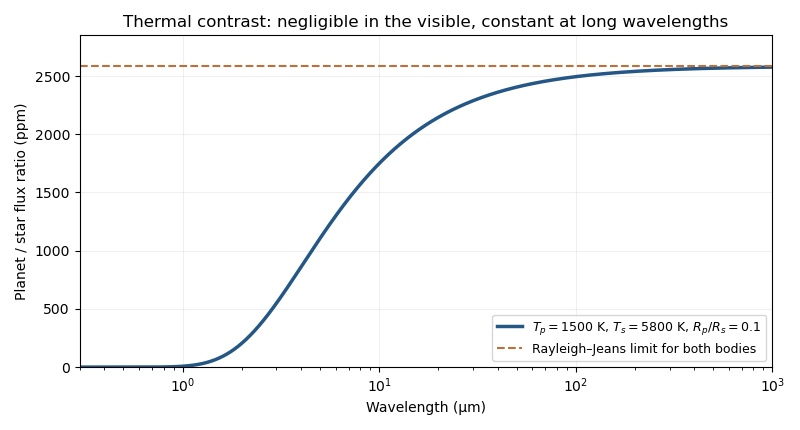
At wavelengths long enough for the Rayleigh-Jeans law to apply to both bodies, . ThereforeThe common dependence cancels. In the illustrative case, the contrast plateau is about , or parts per million.
New to topics? Read the docs here!