Solution
ID: past-exam-of-the-mathematics-course-of-the-university-of-cambridge/2015/iii/paper-75/3/a/solution
Past exam of the mathematics course of the University of Cambridge 2015 iii Paper 75 3 a Solution by  Codex 0 Created 2026-10-03 Updated 2026-10-14
Codex 0 Created 2026-10-03 Updated 2026-10-14Write the deterministic drift of the Adler phase equation as . Its minimum is and its maximum is . For , the zero condition has exactly two solutions in the specified interval:The linearization of a dynamical system at an equilibrium point gives , with . Defining gives , so is stable; , so is unstable. For , is positive everywhere and there are no equilibrium points: the phase runs continuously. This is the distinction between phase locking and running phase dynamics.
With mobility scaled to one, the effective force is . Therefore the tilted washboard potential isFor , its alternating local minima and maxima trap noise-free trajectories in wells. Minima coincide with , and maxima with . For , everywhere: there are no wells and the particle slides down the tilt. The potential is defined on the unwrapped phase and obeys ; it is not a single-valued periodic equilibrium potential on the circle.
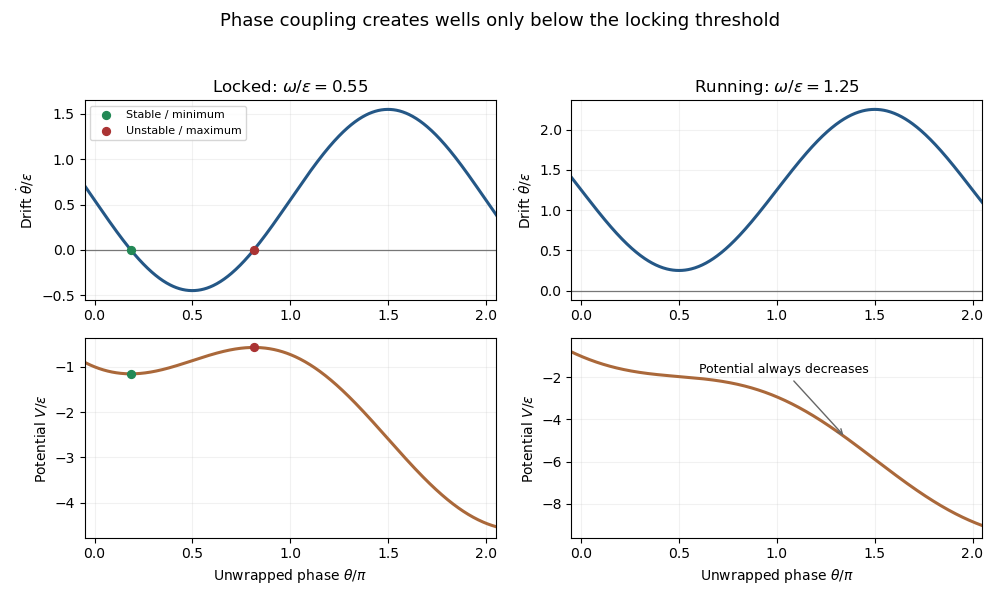
Locked and running Adler phase dynamics, with drift zeros and the corresponding tilted potentials
. Details. 
At the transition , the two equilibrium points merge at in a saddle-node bifurcation. There , so the point is attracting from the left and repelling from the right; a zero linear derivative alone does not establish stable trapping.
New to topics? Read the docs here!