Solution
ID: past-exam-of-the-mathematics-course-of-the-university-of-cambridge/2016/iii/paper-333/3/iv/solution
Past exam of the mathematics course of the University of Cambridge 2016 iii Paper 333 3 iv Solution by  Codex 0 Created 2026-10-03 Updated 2026-10-06
Codex 0 Created 2026-10-03 Updated 2026-10-06Take , a uniform eastward , and the nondivergent Barotropic Rossby wave model. Its dispersion relation is . A stationary wave with hasThe directional component wavelengths are and when nonzero. Differentiating the full dispersion relation before imposing stationarity gives its ground-frame group velocity:Writing , shows . Therefore the stationary Rossby-wave ray envelope at time , for wave packets emitted from a localized mountain throughout , is the diskThe circle is the front of the earliest emissions; later emissions fill ray segments back to the source. The sketch represents the geometrical wave packet envelope, not compact support of the full balanced near field. All propagating wave packet energy lies downstream in this model.
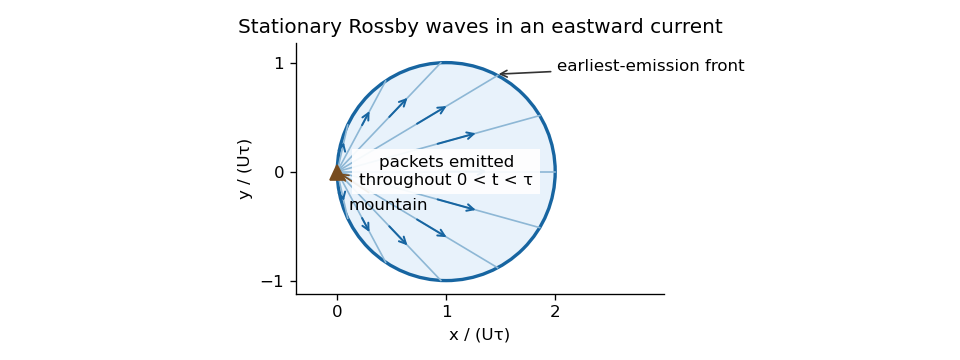
Downstream ray envelope of stationary barotropic Rossby waves emitted by a mountain between zero and the observation time
. If the finite-depth free-surface model of the preceding part is retained consistently, its basic surface slope adds to the potential-vorticity gradient. Stationarity still gives and the same wavelength, but the group velocity is reduced by ; the disk center and radius become . This tends to the plotted nondivergent result as .
A westward wind has no nontrivial stationary propagating planetary Rossby-wave train in this model: would require . Its advective phase motion and intrinsic westward Rossby wave phase motion cannot cancel. A local forced, evanescent response and time-dependent disturbances can still occur. The degenerate limit is not a propagating wave train from an isolated mountain.
New to topics? Read the docs here!