Solution
ID: past-exam-of-the-mathematics-course-of-the-university-of-cambridge/2017/iii/paper-102/3/iv/solution
Past exam of the mathematics course of the University of Cambridge 2017 iii Paper 102 3 iv Solution by  Codex 0 Created 2026-10-03 Updated 2026-10-14
The PDF uses for ; the TeX incorrectly turns this into a power of two. The crystal of the defining odd-orthogonal representation is the chain with weights . Label its vertices . Its directed edge colors areIn particular the short-root string has two edges of color .
For a full drawing of the tensor product of crystals in any rank, take every ordered pair of chain vertices . Let count incoming edges of color along its string, and let count outgoing ones. We use the conventionomitting an edge when the indicated operator vanishes. This crystal tensor-product rule specifies every vertex and every edge; the raising rule uses for its first-factor branch. The picture shows the chain and all 25 tensor vertices for , with connected components distinguished by node color.
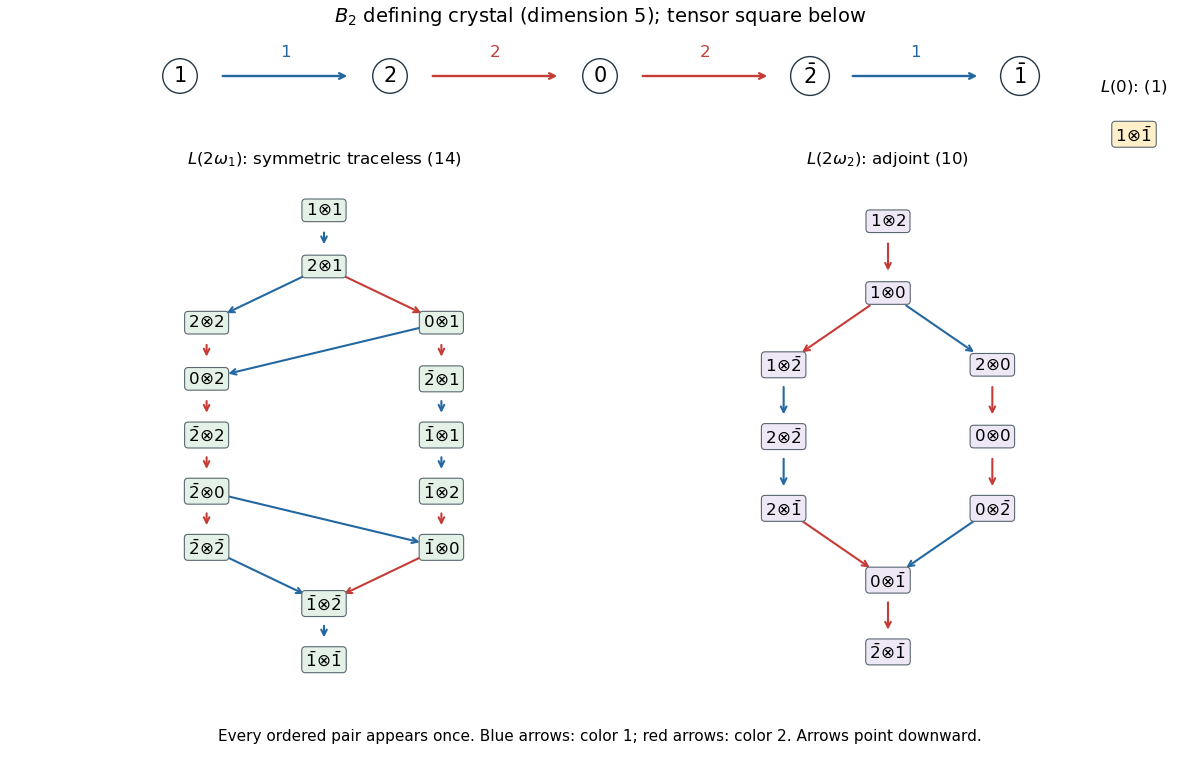
The type-B2 defining crystal and its tensor square
. Details. 
For , the three highest-weight vectors of the tensor crystal are , and . They have weights , and zero. There are no others: a highest tensor vertex must have highest first factor, and the string inequalities then restrict its second factor to these three vertices. ThereforeThe summands are the traceless symmetric square, the exterior square (the Adjoint representation), and the invariant scalar line. Their dimensions are , and one, summing to . For the first two highest weights are ; for they are . For , the three tensor highest vertices are , giving of dimensions .
New to topics? Read the docs here!