Solution
ID: past-exam-of-the-mathematics-course-of-the-university-of-cambridge/2017/iii/paper-338/1/a/i/solution
Past exam of the mathematics course of the University of Cambridge 2017 iii Paper 338 1 a i Solution by  Codex 0 Created 2026-10-03 Updated 2026-10-14
Use azimuth measured from north toward west, and positive hour angle westward. These conventions are forced by the signs in the coordinate formulae. In the diagram the observer is at , the local vertical meets the celestial sphere at the zenith , and the north celestial pole is . The astronomical horizon is perpendicular to ; the celestial equator is perpendicular to . Their intersections with the celestial meridian give the north horizon point and the upper equatorial meridian point.
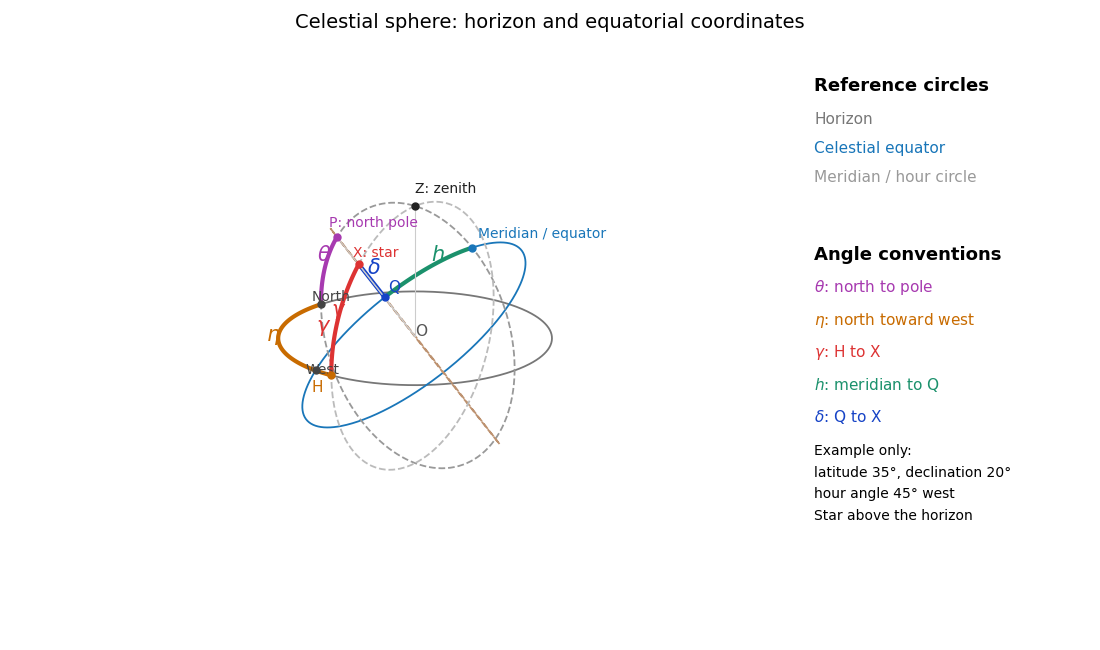
The celestial sphere with horizon and equatorial coordinates
. Details. 
The north celestial pole has altitude ; thus the angle between and is . Project along its vertical great circle onto the astronomical horizon at : the arc is the altitude , and the westward horizon arc from north to is the azimuth . Project along its hour circle onto the celestial equator at : the arc is the declination , and the westward equatorial arc from the upper celestial meridian to is the hour angle . Equivalently the triangle on the celestial sphere has sides , and . All five angles refer to arcs on their specified reference circles, not arbitrary angles in the projected drawing.
New to topics? Read the docs here!