Solution
ID: past-exam-of-the-mathematics-course-of-the-university-of-cambridge/2017/iii/paper-342/3/b/solution
Past exam of the mathematics course of the University of Cambridge 2017 iii Paper 342 3 b Solution by  Codex 0 Created 2026-10-03 Updated 2026-10-14
Put ; here is the dimensionless chemotactic ratio, unrelated to the fluid viscosity in the other questions. Integrating the first-order relation yieldsSubstitute into and separate variables. With ,The first integration constant is fixed by the positive nutrient concentration ahead. The second positive constant can be written , and a translation of the wave origin sets . Indeed with . With that origin choice the nutrient-consuming chemotactic travelling band isThe second formula also follows by differentiating the first and using , so its prefactor is fixed, not a freely chosen independent amplitude.
As , and . As ,Thus all four required limits hold. The singular sensitivity causes no finite- problem, and tends to the finite value behind. Since , is strictly monotone increasing.
For the bacterial peak, differentiate its logarithm:This strictly decreases from to , so it vanishes exactly once. The peak values areAccordingly the nutrient curve is a smooth rising front, and the bacterial curve is a positive pulse, with generally different exponential decay lengths ahead and behind. The nutrient concentration is the undepleted nutrient density in the fresh liquid ahead of the migrating band. Behind the band the nutrient has been consumed. The plot shows the front and pulse for several admissible chemotactic ratios; at the bacterial pulse is symmetric about .
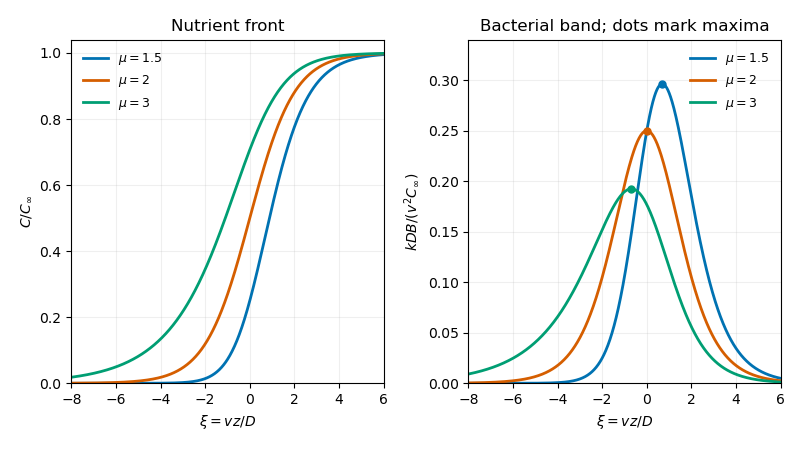

The condition is sufficient for this smooth exponential-tail family. The derivation does not claim to classify all limiting or weak solutions at other parameter values.
New to topics? Read the docs here!