Solution
ID: past-exam-of-the-mathematics-course-of-the-university-of-cambridge/2019/iii/paper-338/1/b/i/solution
Past exam of the mathematics course of the University of Cambridge 2019 iii Paper 338 1 b i Solution by  Codex 0 Created 2026-10-03 Updated 2026-10-14
The echellogram contains nearly parallel traces, one for each diffraction order. Choose the main echelle grating dispersion to increase wavelength toward the right and the cross-disperser to increase wavelength upward. At a fixed horizontal coordinate, order has a shorter wavelength than order , so it lies below order in this convention.
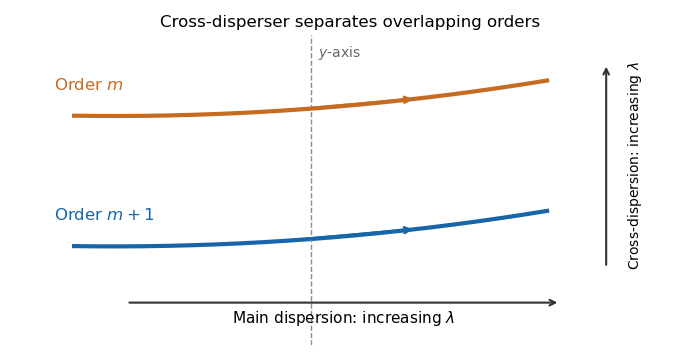
Adjacent orders in a cross-dispersed echellogram
. Order m+1 is bluer than order m at the same main-dispersion coordinate. Within either order, wavelength increases along the trace to the right; the chosen cross-dispersion orientation puts longer wavelengths higher on the detector. Details.
New to topics? Read the docs here!