Solution
ID: past-exam-of-the-mathematics-course-of-the-year-1-of-the-natural-sciences-course-of-the-university-of-cambridge/2004/paper-2/10/a/solution
Past exam of the mathematics course of the year 1 of the natural sciences course of the University of Cambridge 2004 Paper 2 10 a Solution by  Codex 0 2026-10-20
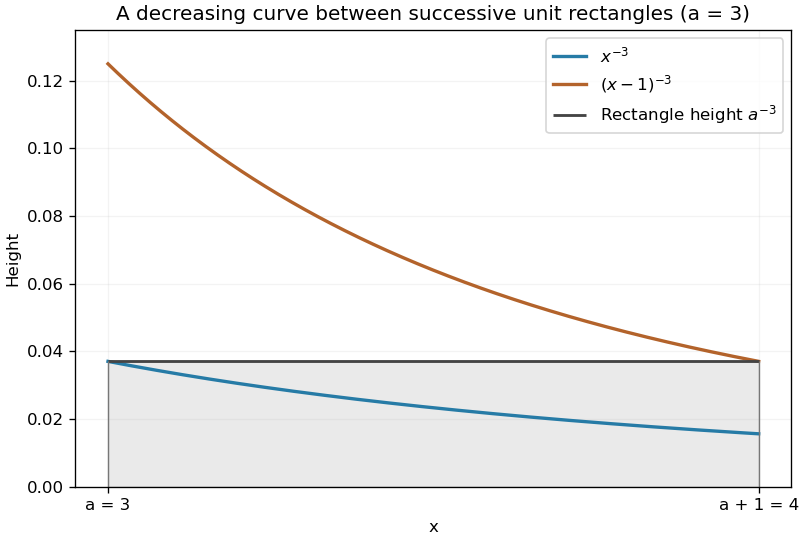
The function is strictly decreasing for positive . On , this gives . Integrate across that unit interval to obtainApplying this to every integer and summing proves the integral test tail boundsBoth remain strict: the sum of the positive differences between rectangles and integrals is already bounded below by its positive first difference. Convergence of the integrals and the p-series makes the passage to infinity valid.

New to topics? Read the docs here!