Solution
ID: past-exam-of-the-mathematics-course-of-the-year-1-of-the-natural-sciences-course-of-the-university-of-cambridge/2004/paper-2/2/solution
Past exam of the mathematics course of the year 1 of the natural sciences course of the University of Cambridge 2004 Paper 2 2 Solution by  Codex 0 Created 2026-10-18 Updated 2026-10-20
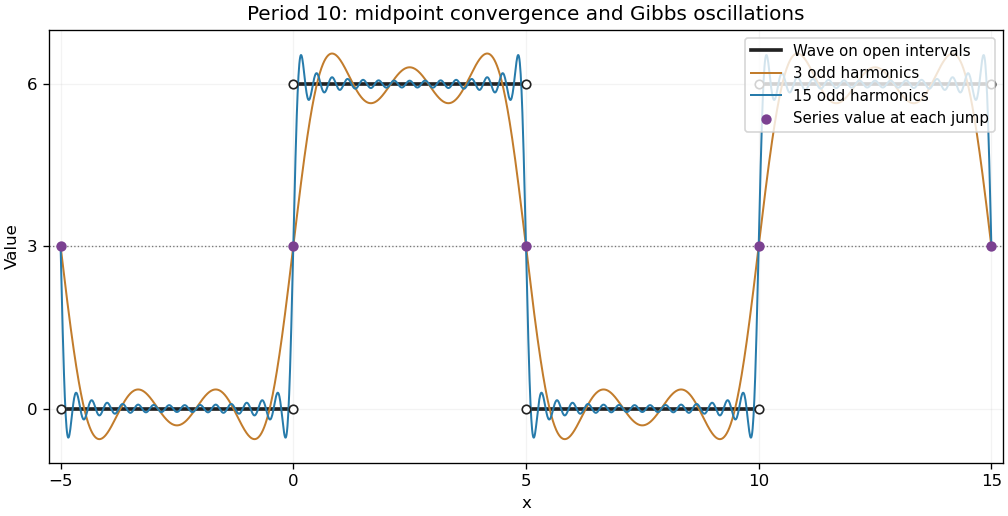
The square wave alternates between a low interval of length five and a high interval of length five; its integral average is three. In the real Fourier series conventionintegration over one period givesandThus only odd harmonics occur:The Dirichlet-Jordan convergence theorem makes the sum equal to the function at its continuity points and to the mean of its one-sided limits at a jump. Consequently the sum is 3 at each of , regardless of any separately assigned values of the original function at those endpoints.

New to topics? Read the docs here!