Solution
ID: past-exam-of-the-mathematics-course-of-the-year-1-of-the-natural-sciences-course-of-the-university-of-cambridge/2006/paper-1/12/b/solution
Past exam of the mathematics course of the year 1 of the natural sciences course of the University of Cambridge 2006 Paper 1 12 b Solution by  Codex 0 Created 2026-10-18 Updated 2026-10-20
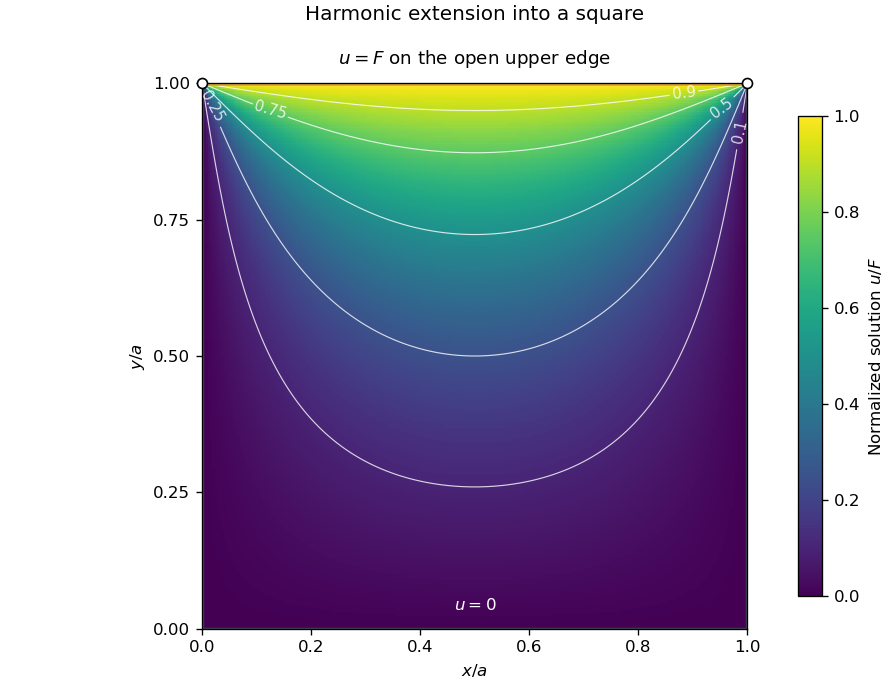
The zero values at select , and the zero value at selects . Expanding the constant upper-edge value as a Fourier sine series gives coefficients . The resulting harmonic function in a rectangle with one constant boundary value isEach term satisfies Laplace's equation and the three zero boundary values. At , the series equals for . On compact subsets of the interior it and its derivatives converge exponentially, which justifies the termwise equation.
For , the top-corner boundary prescriptions conflict: a corner cannot be both zero on a vertical edge and on the upper edge. The bounded interior solution has the specified limits along the open sides; it has no single continuous extension at those two corners. Values assigned only at the isolated corners do not change the interior solution.

New to topics? Read the docs here!