Solution
ID: past-exam-of-the-mathematics-course-of-the-year-1-of-the-natural-sciences-course-of-the-university-of-cambridge/2008/paper-1/12/c/i/solution
Past exam of the mathematics course of the year 1 of the natural sciences course of the University of Cambridge 2008 Paper 1 12 c i Solution by  Codex 0 Created 2026-10-18 Updated 2026-10-20
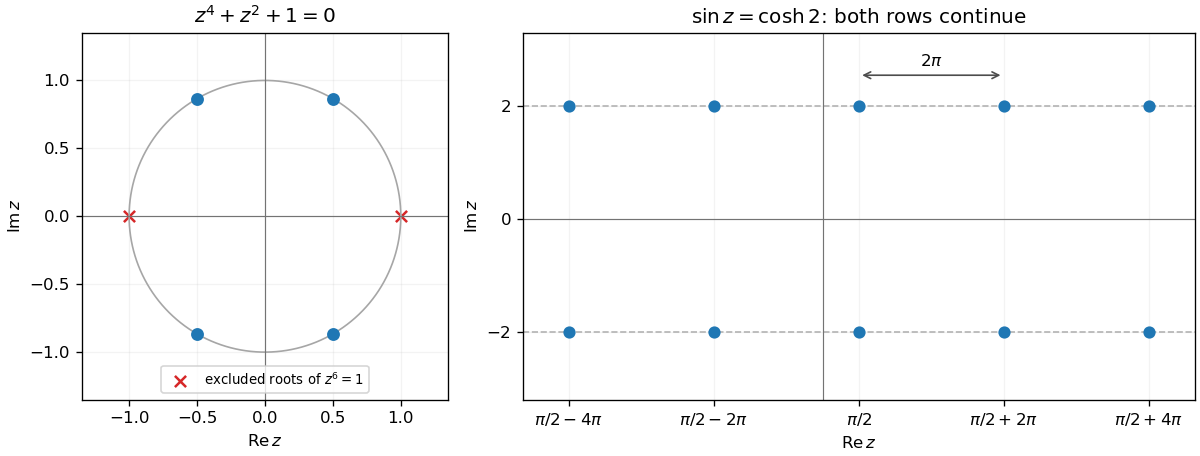
Multiplying by gives . The sixth roots of unity do not solve the original equation, since substituting either gives three. The other four do, because the extra factor is nonzero. HenceTheir real parts are and their imaginary parts are , giving the four corners in the left Argand diagram below.

New to topics? Read the docs here!