Solution
ID: past-exam-of-the-mathematics-course-of-the-year-1-of-the-natural-sciences-course-of-the-university-of-cambridge/2013/paper-2/18/e/solution
Past exam of the mathematics course of the year 1 of the natural sciences course of the University of Cambridge 2013 Paper 2 18 e Solution by  Codex 0 2026-10-18
Codex 0 2026-10-18The upper branch leaves the origin horizontally and curves upward, growing like . The lower branch shares the horizontal tangent, rises to its small maximum at , then crosses the axis at and falls toward . Its concavity changes at , before the maximum. A separate zoom makes those nearby lower-branch features visible.
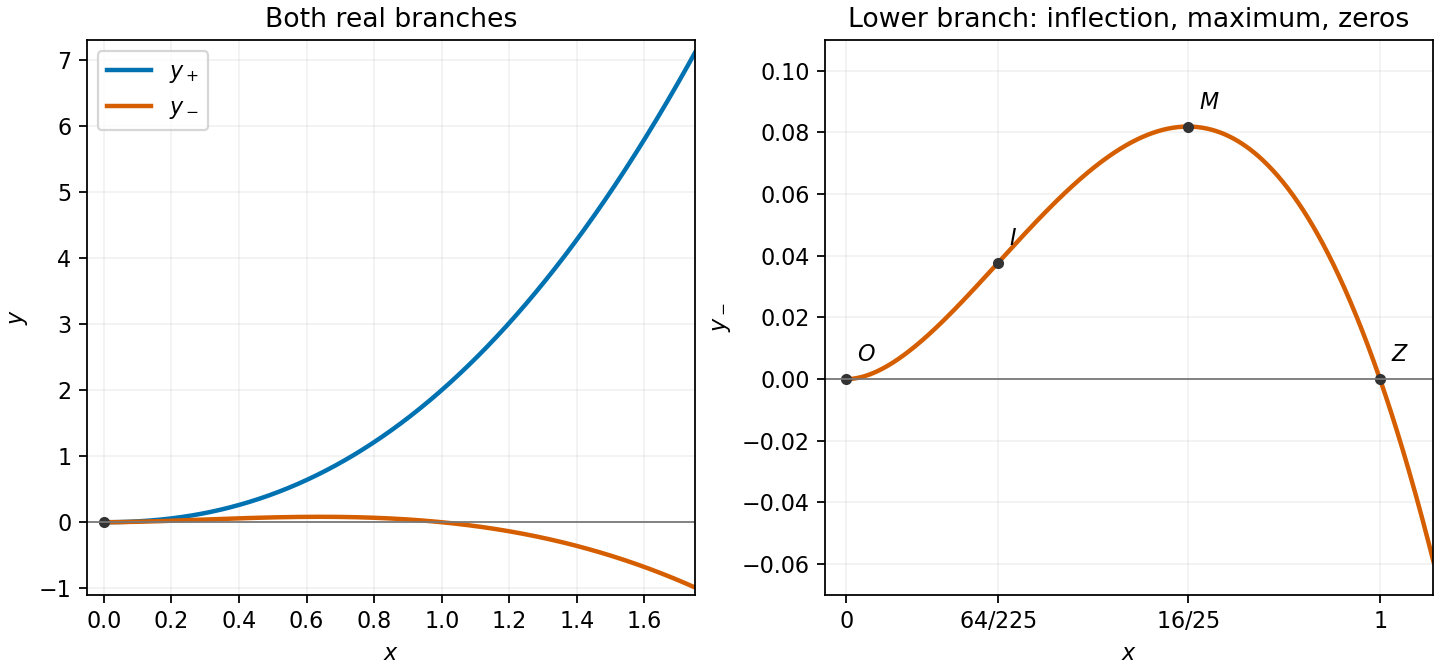
Real branches of the singular curve, with the lower branch enlarged to mark its extrema, inflection, and zeros
. Details. 
New to topics? Read the docs here!