Solution
ID: past-exam-of-the-mathematics-course-of-the-year-1-of-the-natural-sciences-course-of-the-university-of-cambridge/2015/paper-1/20/a/solution
Past exam of the mathematics course of the year 1 of the natural sciences course of the University of Cambridge 2015 Paper 1 20 a Solution by  Codex 0 2026-10-18
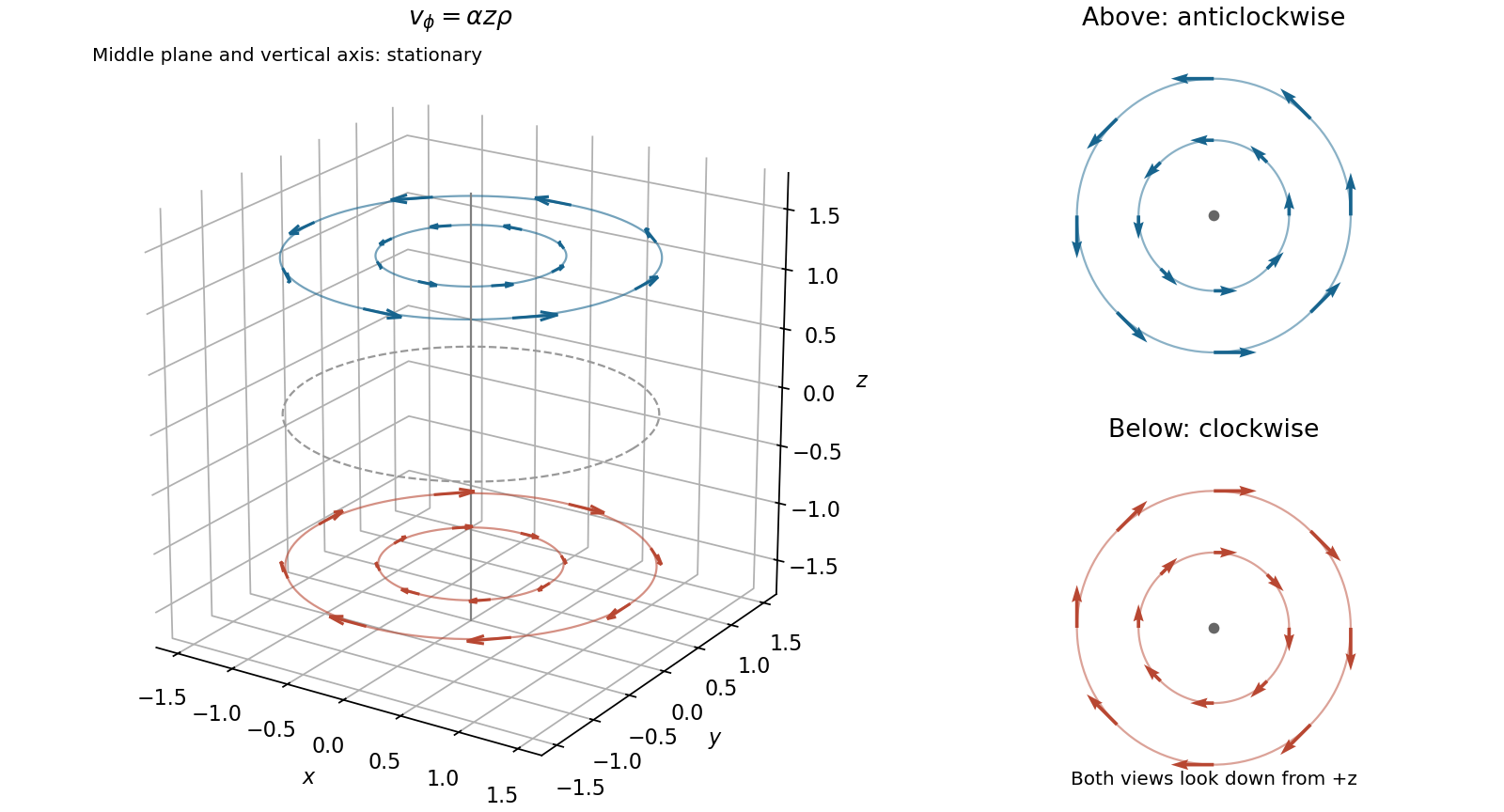
Codex 0 2026-10-18Use cylindrical coordinates , . The velocity field becomesFor each fixed height, particles follow concentric circular streamlines around the vertical axis. At the motion is anticlockwise viewed from above, while at it is clockwise. Within a horizontal plane the angular velocity is , independent of radius, and the speed is . Both the plane and the vertical axis are stationary. The rotation rate varies with height, so the entire liquid is not one rigidly rotating body.

New to topics? Read the docs here!