Solution
ID: past-exam-of-the-mathematics-course-of-the-year-1-of-the-natural-sciences-course-of-the-university-of-cambridge/2016/paper-2/13/a/solution
Past exam of the mathematics course of the year 1 of the natural sciences course of the University of Cambridge 2016 Paper 2 13 a Solution by  Codex 0 2026-10-18
Codex 0 2026-10-18Take for the sketch; changing its sign rotates the picture by . The parametric curve passes through at and through at . As it returns towards the origin, since and . The positive- branch makes a loop in the first quadrant, leaving the origin tangent to the positive axis and returning tangent to the positive axis.
For a more precise sketch, differentiation givesThe loop has its largest at and largest at . Their coordinates are and its reflection in .
The parameter value is excluded. Cancelling the common factor in the sum givesThus the asymptote is . As , and ; as , and . The branch approaches the origin from the fourth quadrant as , while connects the other infinite branch to the origin through the second quadrant.
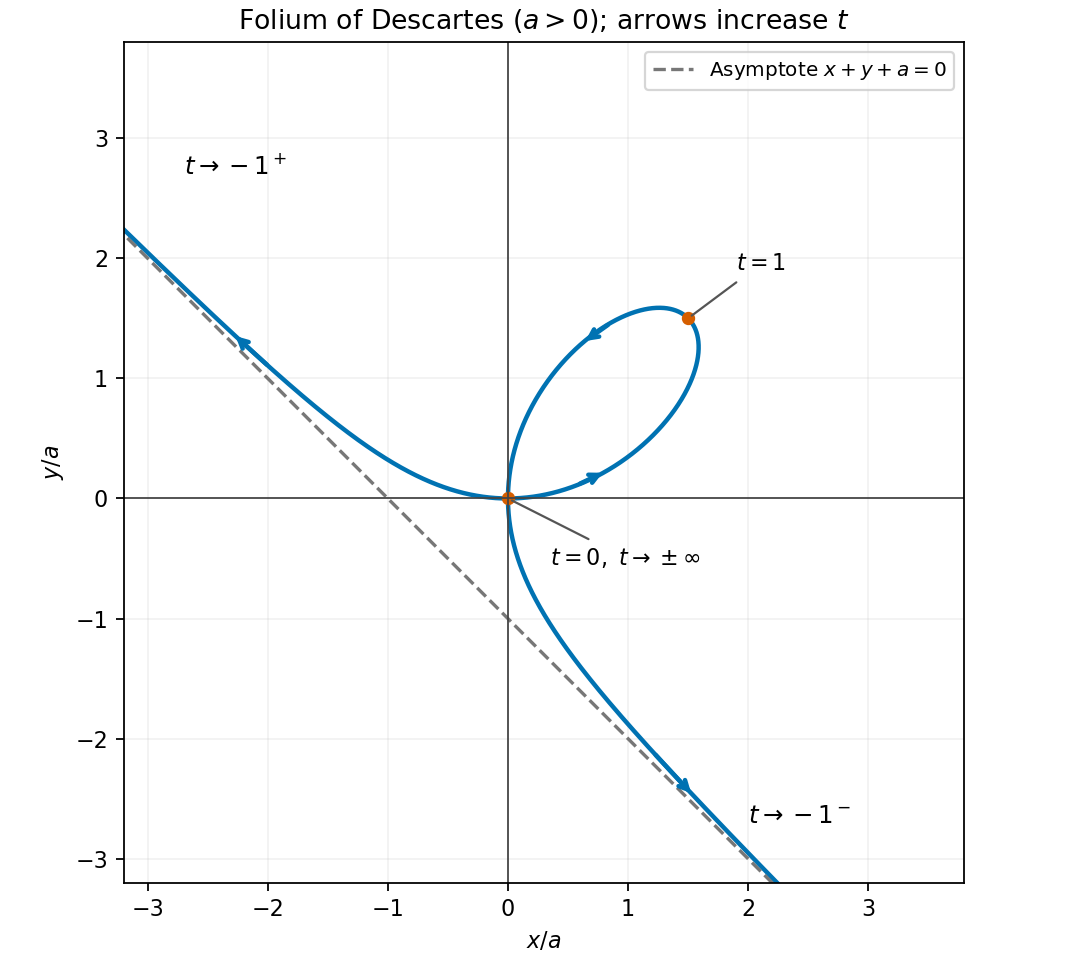

This is the folium of Descartes. If , the parametrization degenerates to the origin for every defined parameter value and there is no nontrivial loop.
New to topics? Read the docs here!